
Reviewed · AUSTIN TOURS
Double Decker Austin Single Loop Sightseeing Tour
Austin’s double-decker loop gives you a quick look at the city’s main sights without making you solve the bus system or walk long blocks in the Texas heat. In roughly 75 to 90 minutes, you pass 6th Street, the Capitol, the University of Texas, South Congress, Lady Bird Lake, and the Congress Avenue Bridge, then return to the Austin Visitor Center.
I like the choice between the breezy open-air upper deck and the climate-controlled lower deck. I also like the live guide, since the best guides, including Jason, Lawrence, and Will, add local stories and practical ideas for what to do next. The main drawback is that this is a sightseeing loop, not a hop-on, hop-off bus. You see many places from the road, but you do not get time to explore each one, and the route may feel too focused on the university for some people.
In This Review
- Key points to know before booking
- Why this short Austin tour works best on day one
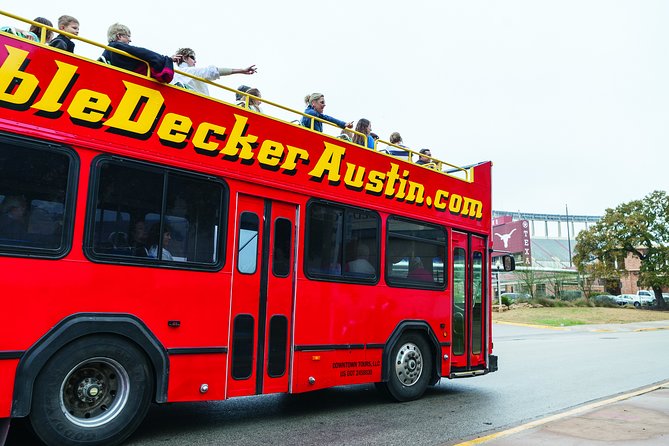
- Choosing between the upper and lower decks
- Starting at the Austin Visitor Center on East Fifth Street
- 6th Street, the Convention Center, and downtown’s older core
- The Driskill Hotel and the Texas Capitol
- UT Austin, the LBJ Library, and the city’s museum quarter
- Congress Avenue Bridge and South Congress
- What the live commentary adds
- Price, timing, and what you actually get
- Who should book this Austin bus ride
- Should you book Double Decker Austin?
- FAQ
- How long does the Double Decker Austin tour last?
- Where does the tour begin and end?
- Can I sit on the open-air top deck?
- Is the tour offered in English?
- What landmarks does the bus pass?
- Can I cancel for a full refund?
Key points to know before booking
- The Texas Capitol is one of the central sights, along with 6th Street, the Driskill Hotel, and the Governor’s Mansion.
- The route also reaches the University of Texas, including the Main Tower, football stadium, museums, and presidential library.
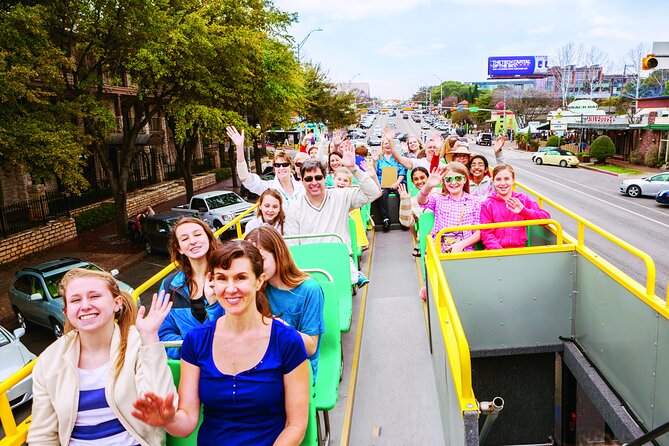
- You can sit upstairs or downstairs, depending on the weather, sun, wind, and your preference for views.
- The tour begins and ends at the Austin Visitor Center, at 103 E 5th Street, near public transportation and parking options.
- The live commentary varies by guide, with many strong reports about friendly, entertaining hosts and a few complaints about rushed or thin narration.
- Book it near the beginning of your stay if you want ideas for restaurants, museums, neighborhoods, and evening plans.
Why this short Austin tour works best on day one
Austin spreads across several areas, and the sights that define the city are not all clustered around the Capitol. A short bus ride helps you understand the basic layout before you spend your time and money on individual museums, restaurants, music venues, and neighborhoods.
I would use this tour as an orientation ride rather than as a full city tour. You get a moving introduction to downtown, the Capitol area, the UT campus, the lakefront, and South Congress. Then you can decide where to return on foot or by local transport.
The tour runs for about 1 hour 15 minutes to 1 hour 30 minutes. That is long enough to cover plenty of ground, but short enough to fit into a first afternoon. One useful approach is to take the ride early in your Austin visit, write down the places that catch your eye, and return later with more time.
The bus carries a maximum of 35 people. That is not a tiny private outing, but it is a manageable size for a city loop. Arrive about 15 minutes before departure for loading. The operator aims to keep a tight schedule, though the bus may wait briefly for late-arriving passengers.
Other Austin days travellers line up against this one:
- Fixer Upper + City Tour
★ 5.0 · 2,989 reviews - Best of Austin Small-Group Driving Tour with Local Guide
★ 5.0 · 2,275 reviews - Top Waco Fixer Upper/City Tour: 5 Star, Award Winning, Affordable
★ 5.0 · 2,104 reviews
Choosing between the upper and lower decks
The top deck is the reason many people choose a double-decker bus. You get a higher view over traffic and buildings, and it is easier to take broad photos of the Capitol, the UT Tower, downtown streets, and Lady Bird Lake.
The upper deck is open to the weather, so think about the forecast before you book. Warm sun, wind, and light clouds can make the ride pleasant. On a hot afternoon, the lower deck may be much more comfortable. A hat and water may help upstairs, though the supplied information does not specify onboard refreshments.
There is one practical issue with the upper level: low tree branches. Some riders have had to duck as the bus passed under branches. This is not a reason to avoid the top deck, but keep an eye ahead and do not assume every street has generous clearance.
The lower deck is climate-controlled. It gives you shelter from heat and wind, though the view is less open. If you have mobility concerns, service animals are allowed, and most people can participate, but the available information does not give detailed step-free access information. Contact the operator before booking if you need a specific seating or boarding arrangement.
Starting at the Austin Visitor Center on East Fifth Street
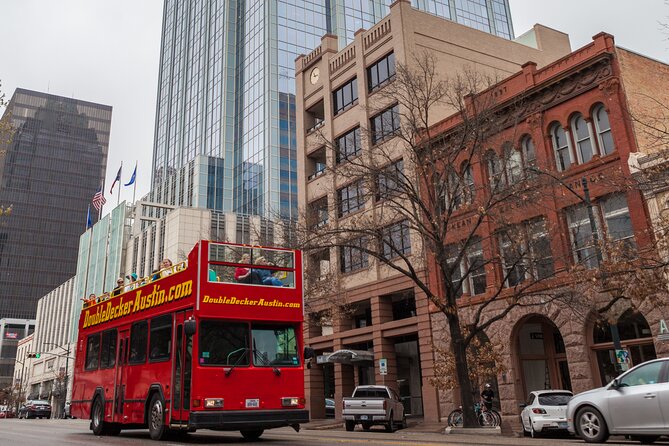
The meeting point is at 103 E 5th Street, at the Austin Visitor Center on Red River Street between 4th and 5th Streets. The activity finishes at the same place, which makes it easy to continue exploring downtown afterward.
The visitor center is useful before or after the ride. You can pick up local information, and the gift shop is an extra stop if you want a souvenir. Parking can be found nearby, including a garage around the corner, and the meeting point is close to public transportation.
I would not cut arrival too close. The bus loads before departure, and getting there early gives you a better chance of choosing your preferred deck and seat. The tour is offered in English, with a mobile ticket accepted for entry.
6th Street, the Convention Center, and downtown’s older core
The loop begins with the Historic 6th Street Entertainment District, one of Austin’s best-known streets for bars, music venues, and nightlife. During daylight, it can look less dramatic than it does after dark, but the guide helps place it in the city’s larger story.
The Austin Convention Center follows as part of the downtown route. This is a useful sight for business visitors and anyone trying to understand how the modern center fits around the older streets.
The bus also passes the Austin Fire Museum in historic Central Fire Station No. 1. Its collection covers Austin firefighting from the 19th through the 21st century, with uniforms, photographs, and memorabilia. You should treat this as a look-from-the-bus introduction, not a museum visit, since the tour does not provide time to go inside.
The Hannig House adds another layer. Built in 1869 for Joseph and Susanna Dickinson Hannig, it connects Austin to the Battle of the Alamo and the founding story of the Republic of Texas. Susanna Dickinson survived the Alamo and carried news of its fall to Sam Houston. It is the sort of small, easy-to-miss house that gains meaning when a guide explains why it matters.
A completely different way to spend a day nearby:
- Austin Biker Gang E-Bike Tour
★ 5.0 · 1,399 reviews - Austin Food Tour with Local Flavors, Tacos & 6 Food Tastings
★ 5.0 · 987 reviews - From Austin: Hill Country BBQ & Wine Shuttle
★ 5.0 · 954 reviews - Austin and Hill Country Sightseeing Tour
★ 4.5 · 928 reviews
The Driskill Hotel and the Texas Capitol
The Driskill Hotel is one of the most memorable buildings on the route. Completed in 1886, it is the oldest operating hotel in Austin and was built by cattleman Jesse Driskill as what he hoped would be the finest hotel south of St. Louis.
You may not have time to enter, but its Romanesque-style exterior makes a good photograph from the bus. The guide’s explanation also gives you a feel for Austin’s early ambition, when cattle money helped shape the city’s grand public and private buildings.
The Texas Capitol is the major architectural stop. It is widely regarded as one of the country’s notable state capitol buildings and has National Register of Historic Places and National Historic Landmark status. The bus route lets you see the scale of the grounds and building without committing to a full Capitol visit.
If you want a detailed look inside, you will need to return on your own. The bus moves on, and one useful criticism from the ride is that it may not slow enough for everyone to study the Capitol and nearby courthouse. Sit where you have a clear forward or side view, and keep your camera ready.
The Governor’s Mansion is another important stop. It has served as the official home of Texas governors and their families since 1856. It is the fourth-oldest continuously occupied governor’s residence in the United States and the oldest west of the Mississippi River.
The mansion suffered serious damage in a 2008 arson attack while it was empty, but it was restored. That story gives the passing view more weight, especially when paired with the Capitol and Austin’s older homes.
UT Austin, the LBJ Library, and the city’s museum quarter
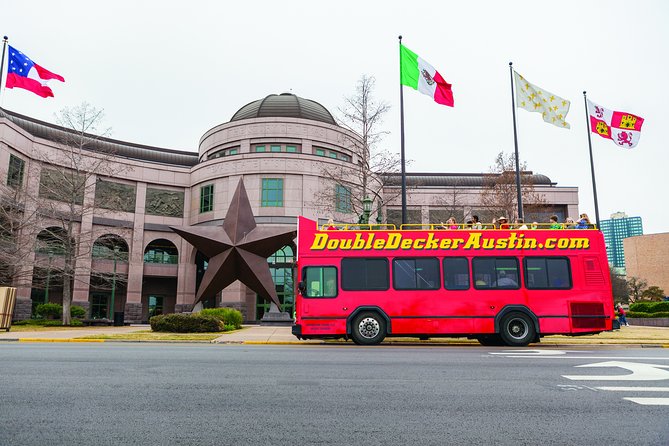
The route spends a noticeable amount of time around the University of Texas. You pass Darrell K Royal Texas Memorial Stadium, home of the Longhorns football team since 1924, and the 307-foot UT Tower, completed in 1937.
You also see the Bullock Texas State History Museum, which opened in 2001 as the official history museum of Texas. The Blanton Museum of Art holds more than 19,000 works, ranging from ancient Greek pottery to abstract expressionism. The Harry Ransom Center focuses on literature, photography, film, art, and the performing arts.
The Lyndon Baines Johnson Library and Museum is another major point of interest. Its exhibits present the presidency and the wider story of LBJ’s time, including successes and failures rather than a polished version of events.
This university section is valuable if you want to visit museums or understand Austin’s academic identity. It is also the most divisive part of the ride. Some people appreciate the extra context and the chance to see the campus. Others feel that too much of the limited tour time goes to UT, especially if they booked the ride mainly for downtown and historic Austin.
The balance depends on your interests. If you enjoy presidential history, art, literature, college football, or public architecture, the campus portion earns its time. If you mainly want neighborhoods west of downtown or a broader city sweep, you may find the route less satisfying.
Congress Avenue Bridge and South Congress
The Congress Avenue Bridge is one of Austin’s most unusual sights because it shelters the largest urban bat colony in North America. Between April and October, roughly 750,000 to 1.5 million bats may emerge near dusk.
The tour does not replace an evening bat viewing, but it tells you where the colony is and helps you plan a return visit. If bats are high on your Austin list, note that the best viewing is near dusk and generally during the April to October season.
From there, the route reaches South Congress, often called SoCo. This neighborhood south of Lady Bird Lake is known for boutiques, eateries, galleries, music venues, and older Austin character. It is one of the most useful areas to scout from the bus because you can return later and explore at street level.
You will also pass the Lady Bird Lake area, the Hike and Bike Trail, Auditorium Shores, and the Long Center. The Long Center presents performances, music, films, festivals, and other local events. These stops show Austin as more than a state capital. They point to the city’s outdoor spaces, arts scene, and social life.
Again, the bus only gives you a first look. South Congress deserves more time than the loop can provide, especially if you want to shop, eat, or browse galleries. Think of the ride as a preview that saves you from wandering without a plan.
What the live commentary adds

A good guide can turn a drive past ordinary buildings into a useful lesson in Austin. The strongest guides listed in the supplied experiences include Jason, Lawrence, and Will. Jason is noted for local recommendations and an entertaining style. Lawrence is described as a warm host with strong Austin and Texas background, while Will combines local information with an outsider’s perspective after moving from the United Kingdom.
Madi is another guide associated with the tour. Her style is energetic and playful, which some people enjoy and others find distracting. That difference matters because the experience depends heavily on who is speaking on the day you ride.
Most of the positive feedback centers on friendly, cheerful delivery, clear explanations, useful history, and suggestions for food and entertainment. A few people felt the guide spoke too quickly, apologized for incorrect information, or left too many buildings unexplained.
You should also know that the commentary may not cover every part of Austin’s story in equal depth. One complaint pointed to limited attention to African American history and the omission of the Barbara Jordan building. That is a fair limitation to keep in mind. The tour touches many major sights, but it cannot provide a full social history of the city in 90 minutes.
Price, timing, and what you actually get
At $36.81 per person, this is not the cheapest way to move around Austin, but the comparison should be with a guided orientation ride, not a city bus fare. You are paying for a reserved seat, the double-decker view, a continuous route, and live narration that ties together downtown, UT, the Capitol, the lake, and South Congress.
The value is strongest if you have only a day or two, are visiting Austin for the first time, or prefer not to walk long distances. It is also useful for families and mixed-age groups because you can see a lot without asking everyone to keep walking.
The value is weaker if you already know downtown, want to enter museums and historic buildings, or expect a hop-on, hop-off service. You will pass many places, but the activity ends back at the visitor center rather than providing scheduled stops for independent exploring.
The tour requires good weather. If poor weather cancels it, you can receive a different date or a full refund. You can cancel for a full refund up to 24 hours before the start time. Within 24 hours, the fare is not refunded, and changes are not accepted.
Who should book this Austin bus ride
I would recommend it to first-time visitors who want a quick city map in their heads. It is especially helpful if you are deciding among the Capitol, UT museums, South Congress, the bat bridge, and downtown nightlife.
It also suits people who want a low-effort sightseeing option. The climate-controlled lower deck can be a sensible choice on a hot day, while the upper deck offers the better view in comfortable weather.
Families, couples, solo visitors, and local residents showing relatives around can all find a reason to take it. Solo riders may enjoy the easy format, and the staff are described as warm and helpful. The gift shop and visitor center make the start and finish convenient.
I would hesitate if your top priority is a detailed neighborhood tour, a strong focus on African American history, or extensive time around west downtown. I would also skip it if you dislike sitting through a fixed route or if you want to get off repeatedly at museums and attractions.
Should you book Double Decker Austin?
Book this tour if you want a well-priced first look at Austin and understand that most sights are viewed from the road. Take it early in your stay, arrive 15 minutes ahead, and choose the upper deck when weather and tree clearance allow.
The strongest reason to go is the range: in one short ride, you see the Capitol, 6th Street, the Driskill, UT, the LBJ Library, the bat bridge, South Congress, Lady Bird Lake, and the Long Center. The main caution is uneven guiding and a route that gives the university a substantial share of the time.
For many people, that tradeoff is worthwhile. You finish with a better sense of where Austin’s key areas sit and a practical list of places to revisit. Just do not confuse this pleasant overview with a full tour of every neighborhood or an admission ticket to the sights along the way.
FAQ
How long does the Double Decker Austin tour last?
The ride lasts approximately 1 hour 15 minutes to 1 hour 30 minutes.
Where does the tour begin and end?
It begins and ends at the Austin Visitor Center, at 103 E 5th Street in Austin. The bus meeting area is on Red River Street between 4th Street and 5th Street.
Can I sit on the open-air top deck?
Yes. You can choose the open-air upper deck or the climate-controlled lower deck. The upper deck is more exposed to sun, wind, weather, and low tree branches.
Is the tour offered in English?
Yes. The tour is offered in English and includes live commentary from a guide.
What landmarks does the bus pass?
The route includes sights such as 6th Street, the Austin Convention Center, the Driskill Hotel, the Texas Capitol, the Governor’s Mansion, the University of Texas, the LBJ Presidential Library, the Congress Avenue Bridge, South Congress, Lady Bird Lake, and the Long Center.
Can I cancel for a full refund?
Yes. You can cancel at least 24 hours before the experience start time for a full refund. Cancellations or changes made less than 24 hours before the start time are not accepted for a refund.
Recently reviewed around Austin
- Austin Small Group Morning Walk★ 5.0 · 412 reviews
- Austin Electric Bike Tour: Let it Ride★ 5.0 · 892 reviews
- Austin and Hill Country Sightseeing Tour★ 4.5 · 928 reviews
- Austin Food Tour with Local Flavors, Tacos & 6 Food Tastings★ 5.0 · 987 reviews
- From Austin: Hill Country BBQ & Wine Shuttle★ 5.0 · 954 reviews
- Austin Guided Outdoor Climbing Experience★ 5.0 · 386 reviews
- The Escape Game: Epic 60-Minute Adventures in Downtown Austin★ 5.0 · 358 reviews
- Austin Live Music Crawl★ 5.0 · 485 reviews
Austin Tours, compared.

Best of Austin Small-Group Driving Tour with Local Guide
Read our review →
Top Waco Fixer Upper/City Tour: 5 Star, Award Winning, Affordable
Read our review →

Austin Food Tour with Local Flavors, Tacos & 6 Food Tastings
Read our review →


Browse the lists this tour appears in