
Reviewed · AUDIO TOURS
Gettysburg Battlefield Self-Guided Driving Audio Tour
Gettysburg is easiest to grasp when you can see the ground as the battle unfolded. This self-guided drive takes you from McPherson’s Ridge to Pickett’s Charge, using GPS-triggered narration to connect hills, farms, monuments, and roads with the soldiers who fought there. You ride in your own car, not on a bus with a fixed schedule.
I like the freedom to stop and start whenever you wish, and I like the price: $16.99 covers the whole car for up to four people. The side stories, including Battlefield Sallie and the hurried evacuation of local farms, give the tour more human weight than a simple list of monuments.
The main caution is the app. Most people find it easy once set up, but some users have had trouble with the starting point, GPS timing, or audio restarting. Download the tour on strong Wi-Fi or cellular service, practice with the app before setting off, and follow the marked route and speed limit.
In This Review
- Key points before you set out
- A battlefield tour built around the ground
- First day of battle: McPherson’s Ridge to the Eternal Light
- Day two: monuments, farms, and the fight for the hills
- Pennsylvania pride and the defense of Culp’s Hill
- Day three and Pickett’s Charge
- What the $16.99 price really gets you
- The app is the part to handle carefully
- Who should choose this Gettysburg tour?
- Practical details worth knowing
- Should you book it?
- FAQ
- How much does the Gettysburg Battlefield Self-Guided Driving Audio Tour cost?
- How long does the driving tour take?
- Where does the tour begin?
- Where does the tour end?
- Is a guide provided in person?
- Does the tour work without phone service?
- What language is available?
- Are admission tickets included?
- Can I pause the tour or use it again later?
Key points before you set out
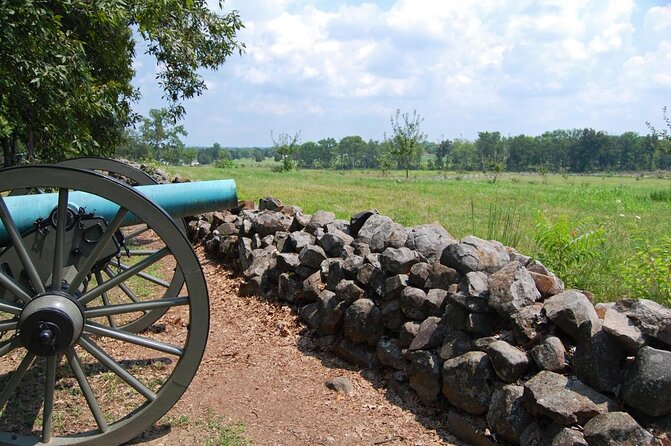
- More than 60 audio stories guide you along a route of over 19 miles.
- One $16.99 purchase covers up to four people, making this a strong choice for families and couples sharing a car.
- GPS-triggered narration plays as you reach each location, with offline maps for areas where phone service may be weak.
- The route follows the official Auto Tour, covering McPherson’s Ridge, Little Round Top, Devil’s Den, the Peach Orchard, Culp’s Hill, Pickett’s Charge, and the National Cemetery.
- You control the pace, with time for photos, monuments, food breaks, or optional side trips.
- The tour is in English only, and admission to museums or other attractions is not included.
A battlefield tour built around the ground
The best feature here is the simple act of driving from one position to the next. Gettysburg can feel like a vast collection of statues and stone walls until someone explains why a ridge mattered, how a road shaped troop movement, or why a farm became a hospital. The audio gives you that thread while you look out the window.
The route takes about one to two hours if you keep moving, but you should allow two to four hours if you stop at monuments, observation points, and the museum. You can also pause the tour and return later because access does not expire under the current terms. That is useful if you are spending several days in Gettysburg or want to split the battlefield into shorter visits.
You begin at the Gettysburg Heritage Center parking area at 297 Steinwehr Avenue, or at the National Park Visitor Center. No guide meets you there. Instead, you open the separate Action Tour Guide app, enter the password sent by email and text, and start the version that matches your chosen starting point and direction.
The audio plays automatically when you reach each story point. Connect your phone to the car through Bluetooth, USB, or AUX. Apple CarPlay supports audio playback, though the map display is not yet available through CarPlay. An iPhone with iOS 15 or later, an Android device with version 9 or later, or a GPS-equipped cellular tablet is recommended.
More the USA trips worth a second look
- Fort Sumter Admission and Self-Guided Tour with Roundtrip Ferry
★ 4.5 · 3,343 reviews - San Francisco: Alcatraz Ticket, Ferry, & Self-Guided App
★ 4.5 · 2,460 reviews - Los Angeles: Hop-On Hop-Off Bus Tour with Audio Guide
★ 3.7 · 2,030 reviews
First day of battle: McPherson’s Ridge to the Eternal Light
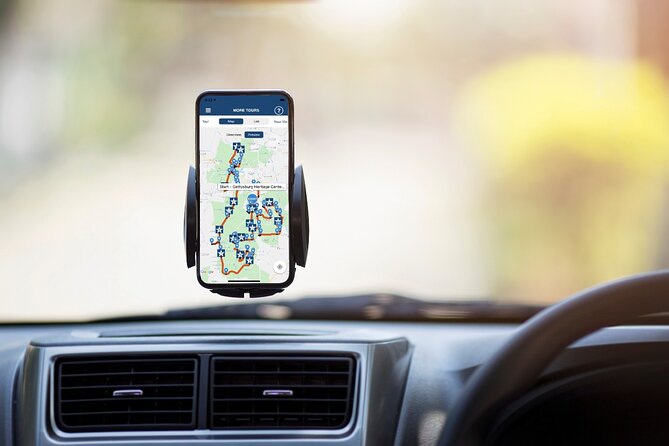
Your first major battlefield stop is Gettysburg Auto Tour Stop 1 at McPherson’s Ridge. This is where the opening fighting of July 1 began, as Union and Confederate forces rushed regiments into position. The ridge gives the story a physical setting, allowing you to picture how the armies met rather than hearing only a timeline of names and dates.
Next comes the Railroad Cut, an unlikely place for a major first-day clash. The audio explains the strategies used by commanders on both sides and introduces several of the people caught in the fighting. This is the sort of stop where the narration matters most, since the cut itself may not immediately reveal why it was important.
The Eternal Light Peace Memorial provides a quieter pause. Maine granite forms its base and Alabama limestone forms the pillar, a deliberate symbol of reconciliation between North and South. The memorial was dedicated to national reunification, so it changes the tone from battlefield tactics to the long effort to repair a divided country.
At Oak Ridge Observation Tower, you get one of the better views of the opening day’s battlefield. The height helps you see why commanders cared about ridges and open fields. Check current access conditions before counting on climbing the tower, but the audio still gives you the story and setting even if you stay at ground level.
The 11th Pennsylvania Volunteer Infantry Monument has a memorable detail: a dog sculpted on the base. Battlefield Sallie served as the regiment’s mascot and stayed with the soldiers through much of the Civil War. The narration also explains the role of drummers and military music, a welcome change from battle maps and command decisions.
As evening closes over the first day, the tour shifts to the problem facing Union soldiers. They have suffered heavy losses and given up ground. You hear how the generals assessed the situation and prepared for another day, which helps explain why the second day was not simply a continuation of the first.
Day two: monuments, farms, and the fight for the hills
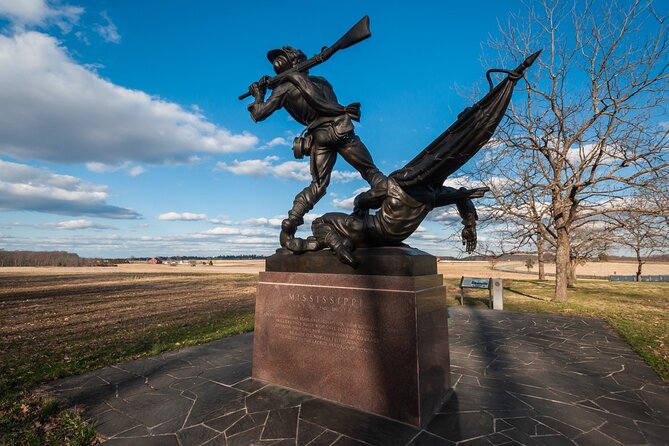
The route passes the North Carolina Memorial and Virginia Monument, two large memorials that reflect the scale of Southern participation in the battle. You do not need to stop at every monument to follow the story, but these sites reward a slower pace if you have time.
Gettysburg Auto Tour Stop 5 introduces the second day of fighting. The same point later connects to Pickett’s Charge, but here the focus is on troop organization and the plans forming before the major attacks. Saving the famous charge for later gives the tour a useful sense of sequence.
The Longstreet Observation Tower offers another broad view over the second day’s action. From this part of the route, the audio sets up the movements of Confederate troops and the Union positions they hoped to break.
An optional detour leads to the Eisenhower National Historic Site, the farm overlooking the battlefield where President Dwight Eisenhower often stayed. The detour adds presidential history to the military story, but it also takes time, so you may prefer to save it for a separate visit.
At Warfield Ridge, Confederate troops gathered for an attack on a key Union position. Union marksmen were specially trained and ready to defend it. The location makes clear how much of Gettysburg came down to position, visibility, and the ability to hold a line under pressure.
Little Round Top is one of the battlefield’s essential stops. Union troops barely held the hill against Confederate attacks, protecting a position that helped keep the Union line intact. As the road curves around the area, you hear about the Valley of Death, a name that needs little explanation after learning what happened there.
Nearby Devil’s Den gave Confederate sharpshooters cover among its volcanic rocks. From those positions, they could fire at Union soldiers with protection from return fire. The site is visually distinctive, and the tour’s narration helps connect the rocks to the tactical choices made on the second day.
Gettysburg Auto Tour Stop 9 brings you to the Wheat Field, another major second-day fight. The narration places you alongside Union soldiers trying to hold against Confederate pressure and includes the unusual story of Union soldier JJ Purman. This is a good place to get out, walk a little, and let the scale of the fighting sink in.
At the Peach Orchard, the audio follows the battle’s changing plans and shows which strategies began to work and which failed. The name sounds peaceful, but the location became a major point of combat. You will get more from this stop if you read the nearby markers and compare the open ground with the spoken account.
The Abraham Trostle Farm adds a civilian angle. The Trostle family fled so quickly that dinner remained on the table. That small detail makes the battle less abstract. It reminds you that the armies were moving through working farms where families had homes, animals, crops, and little time to prepare.
Gettysburg Auto Tour Stop 11 at Plum Run follows soldiers who escaped the fighting near the Peach Orchard. The story continues through movement and retreat rather than treating each stop as an isolated event.
At the George Weikert Farm, the human cost becomes even more direct. The Weikert family evacuated, then returned to find their farm turned into a battlefield hospital. The audio explains the work of military doctors and the physical effects of war, making this one of the more sobering stops.
Pennsylvania pride and the defense of Culp’s Hill
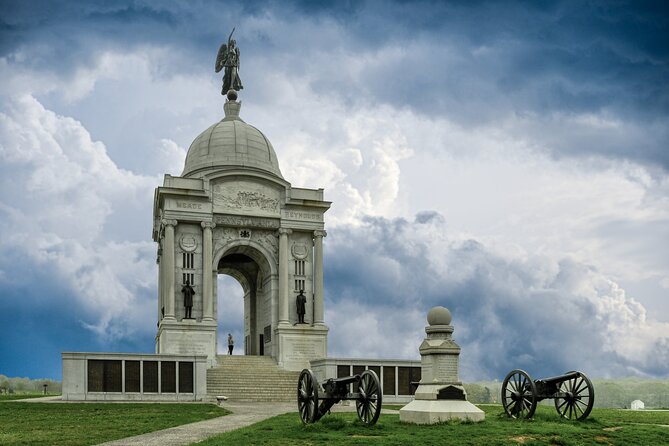
The Pennsylvania Monument honors nearly 35,000 Pennsylvanian soldiers who fought at Gettysburg. The narration gives the memorial extra meaning by stressing that many of these men were defending their own state, not just serving a distant national cause.
Spangler’s Spring is a smaller site with an important role. The tour explains why this water source mattered before leading you toward Culp’s Hill Tower. The woods can make the battlefield feel less open here, so listening closely is useful for understanding how troops moved and why control of the hill mattered.
At Culp’s Hill, Union and Confederate forces fought for a strategic position. Union soldiers held the hill until evening, giving the Union line a vital defensive success. The area also shows why Gettysburg is not only about dramatic charges across open fields. Woods, slopes, springs, and narrow approaches shaped the fight too.
East Cemetery Hill brings the second day to a close. After dark, Confederate forces tried a nighttime raid because they had not fully taken Culp’s Hill. The Union came close to losing here, but perseverance, skill, and luck helped hold the position.
This is a natural point to pause the tour. You can stop for a meal in town, return the next morning, or continue if you still have energy. The ability to split the route is one reason this format works better than a timed bus tour for many people.
A completely different way to spend a day nearby:
- NYC: SUMMIT One Vanderbilt Tickets
★ 4.7 · 51,195 reviews - NYC: 9/11 Memorial & Museum Timed-Entry Ticket
★ 4.8 · 31,428 reviews - NYC: Empire State Building Tickets – Observatory & Museum
★ 4.7 · 25,757 reviews - NYC: Empire State Building Observation Deck Tickets
★ 4.7 · 22,072 reviews
Day three and Pickett’s Charge
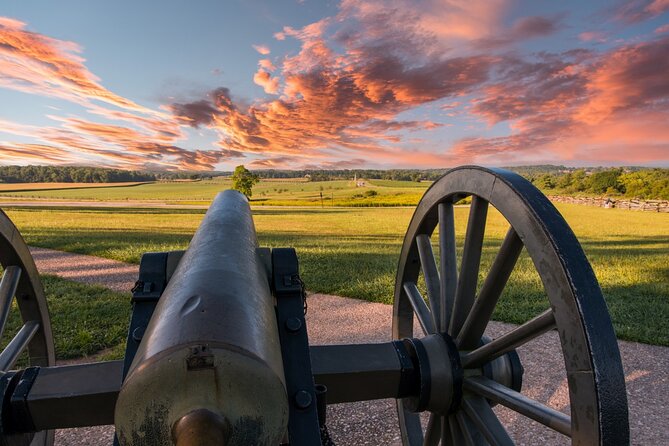
The Gettysburg National Military Park portion frames the battle’s wider importance. The defeat ended Robert E. Lee’s second invasion of the North and became known as the High Water Mark of the Rebellion. The audio also connects Gettysburg to Abraham Lincoln’s Gettysburg Address, delivered months later at the dedication of the soldiers’ cemetery.
Gettysburg Auto Tour Stop 15 presents Pickett’s Charge. From the Union position, you look across the open ground where Confederate troops advanced toward the defensive line. The tour identifies the high-water mark, the farthest point reached by the Confederacy during the assault.
This is one of the moments when being in your own car helps. You can stop, get out, read the monuments, and take in the distance without being hurried along. You can also replay the story if the first explanation goes by too quickly.
The final stop is Gettysburg National Cemetery, at 125 Taneytown Road. The tour ends among the graves of Union soldiers and at the site associated with Lincoln’s address. The short speech was expected to be longer, but Lincoln believed the fallen soldiers deserved the attention. That closing idea gives the drive a fitting end.
What the $16.99 price really gets you

At $16.99 per group of up to four, this is inexpensive if you have a full car. A family of four pays less than $4.25 per person, and a couple still pays under $9 each. You are also buying lifetime access with no expiration, so the value improves if you return to Gettysburg or want to hear only selected sections again.
You do not pay extra for each person in the car. The price does not include museum admission, attraction tickets, or reservations, so plan those separately. The Gettysburg Heritage Center is recommended as part of the visit, but its admission is not included.
The tour also gives you something a standard drive through the park does not: a planned order and spoken explanation. You could follow the park road on your own, but it is easy to miss why one ridge mattered more than another. The audio provides structure without charging the premium of a private guide.
The app is the part to handle carefully
The Action Tour Guide app is separate from the booking platform. Search your email and text messages for the audio tour instructions, download the app, and enter the supplied password. Download all tour material while you have strong Wi-Fi or cellular service, since the tour works offline after that.
Start at the Heritage Center or National Park Visitor Center. If several tour versions appear, choose the one that matches your starting point and direction. The GPS system depends on your position, route, and speed, so do not improvise with shortcuts if you want the chapters to trigger correctly.
A few users have had to restart the tour or repeat sections because the GPS lost sync. Starting from the correct point, staying on the official route, and observing the posted speed limit should give the system the best chance to work properly. It is wise to test the first story before pulling away.
The narrator is not identified by name in the tour information, but the audio has earned strong praise for its clear, pleasant delivery. The app also offers extra material through learn more options at many stops, which is useful if you want more than the main story.
Who should choose this Gettysburg tour?

I would choose this for independent visitors, families, couples, and anyone who dislikes being rushed. It works particularly well for a camper van or a private car, since you can stop where you like and take breaks without holding up a group.
It is also a good fit for repeat visitors. You can hear the main route one day, return to Little Round Top or the Wheat Field later, and use the same purchase again. Families with older children may appreciate the mix of statues, cannons, farms, dramatic attacks, and personal stories.
I would think twice if you want a live historian beside you, detailed question-and-answer time, or a fully guided walking experience. The app can explain the sites, but it cannot respond to your questions or adjust the story to your interests in real time. English is the only available language.
Practical details worth knowing
The experience is private to your group, and most people can participate. It is near public transportation, but the route itself is designed for a private vehicle. Allow extra time for photos, monument reading, and the Eisenhower detour.
Free cancellation is available if you cancel at least 24 hours before the local start time. Cancellations or changes made within 24 hours are not refundable.
Should you book it?
Book this tour if you want a low-cost, flexible way to understand the Gettysburg battlefield from your own car. The route covers the major sites, the narration adds useful personal details, and lifetime access gives you room to take the visit slowly.
Skip it if app setup frustrates you or if you need a live guide. For everyone else, download it before arriving, begin at the correct starting point, and allow at least half a day. Gettysburg rewards patience, and this tour gives you the freedom to supply it.
FAQ
How much does the Gettysburg Battlefield Self-Guided Driving Audio Tour cost?
The tour costs $16.99 per group, with up to four people covered by one purchase.
How long does the driving tour take?
The driving route itself takes about one to two hours without long stops. Allow two to four hours if you plan to explore monuments, take photos, visit optional sites, and pause for breaks.
Where does the tour begin?
You can begin at the Gettysburg Heritage Center parking area at 297 Steinwehr Avenue or at the National Park Visitor Center.
Where does the tour end?
The route ends at Gettysburg National Cemetery, at 125 Taneytown Road in Gettysburg.
Is a guide provided in person?
No. This is a private, self-guided activity. No one meets you at the starting point, and the narration is delivered through the Action Tour Guide app.
Does the tour work without phone service?
Yes. You must download the tour while connected to strong Wi-Fi or cellular service. After downloading, the audio and offline maps work without a signal.
What language is available?
The tour is offered in English.
Are admission tickets included?
No. Museum admission, attraction tickets, and reservations are not included in the tour price.
Can I pause the tour or use it again later?
Yes. You can pause for meals, photos, and side trips, and the current tour terms provide lifetime access with no expiration.
Recently reviewed around the USA
- Dyker Heights Christmas Lights Guided Tour★ 4.5 · 920 reviews
- New York City Dinner Cruise with Live Music★ 4.0 · 377 reviews
- New York City Holiday Lights Tour★ 4.5 · 664 reviews
- NYC in a Day Tour: Statue of Liberty, Times Square and More★ 5.0 · 366 reviews
- Broadway and Times Square Insider Tour with Theater Professional★ 5.0 · 651 reviews
- NYC Central Park Bicycle Rentals★ 4.5 · 368 reviews
- Central Park Bike Rental New York City★ 4.0 · 560 reviews
- Manhattan Sky Tour: New York Helicopter Flight★ 4.5 · 1,458 reviews
Audio Tours, compared.


City Sightseeing Hop-On Hop-Off Bus Tour with Audio Guide
Read our review →
Medieval Torture Museum Ticket with Audio Guide and Ghost Hunting
Read our review →

Ultimate Acadia National Park Self-Guided Driving Audio Tour
Read our review →
Browse the lists this tour appears in