
Reviewed · SKIP THE LINE
Skip-the-line: Art Institute of Chicago Guided Tour
The Art Institute of Chicago is so large that a first visit can become a march through galleries without much sense of what matters. This small-group tour of 12 or fewer gives you a clear route through the museum’s major works, from Seurat and Van Gogh to Hopper, Picasso, and Warhol.
I like two things right away: the guide handles the museum geography, and the commentary goes beyond dates and art labels. Guides such as Joel, Bernie, Scout, Colleen, and Arnold are praised for mixing artist stories, Chicago history, humor, and useful context. The skip-the-line entry also saves precious time.
The tradeoff is pace. Two and a half hours is enough for a strong introduction, not a quiet study of every masterpiece. You may see many top works but have little time to linger, and one guest felt the tour covered the museum more than the art itself.
In This Review
- Key points to know before you book
- Why the Art Institute needs a planned route
- Beginning with Tiffany glass and Chicago scale
- Paris Street and the drama of modern city life
- Seurat’s dots and the museum’s Impressionist strength
- Van Gogh’s bedroom and the power of a familiar image
- O’Keeffe, Hopper, and the American collection
- A pause for the unsettling Picture of Dorian Gray
- Chagall, Picasso, and the pleasures of visual invention
- Warhol and Pollock close the modern-art sweep
- What the guide adds to the museum visit
- The pace, group size, and physical effort
- Is $71.40 a good value?
- Who should book the 10:30 am tour?
- Should you book the Art Institute guided tour?
- FAQ
- Where does the tour begin?
- What time does the tour start?
- How long does the tour last?
- Is museum admission included?
- How large is the tour group?
- Is the tour offered in English?
- Is the ticket mobile?
- Does the tour include skip-the-line entry?
- Where does the tour end?
- Can I cancel for a full refund?
Key points to know before you book
- A greatest-hits route in 2.5 hours: Expect major works by Van Gogh, Seurat, Hopper, O’Keeffe, Picasso, Pollock, and others.
- Small groups capped at 12: You get a more personal setting and a better chance to ask questions than on a large coach-style tour.
- Guides bring the art to life: Joel, Bernie, Scout, Colleen, Arnold, Michelle, Robert, and Marlin have all been praised for clear explanations and lively storytelling.
- Admission is included: The ticket covers entry, and the tour ends back at the museum meeting point.
- Best for a first visit: This works especially well if you have limited time in Chicago or do not know how the museum is organized.
- Plan for plenty of walking: A moderate level of physical fitness is recommended, and your feet may notice the length before your mind does.
Why the Art Institute needs a planned route
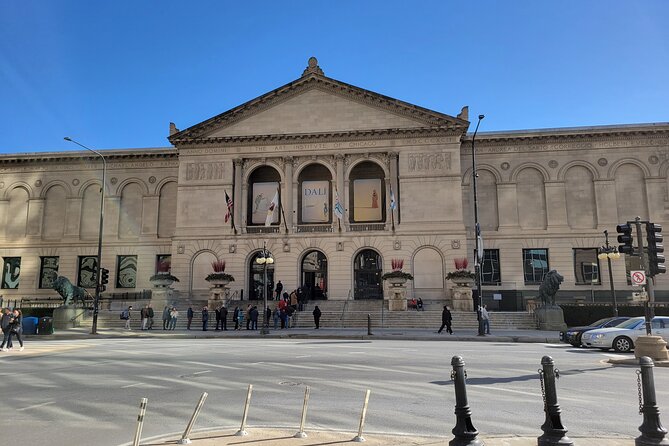
The Art Institute of Chicago is not a small museum you can casually cross off in an hour. Its collection ranges across centuries, countries, and styles. That variety is its strength, but it can also make the place feel scattered if you arrive without a plan.
This tour gives you a route and a story. Instead of guessing which corridor leads to the next famous painting, you follow a guide who selects key rooms and explains why the works matter. That is a real benefit for a first visit, especially if your Chicago schedule is tight.
The tour begins at 10:30 am at 111 S Michigan Ave. It lasts about two hours and 30 minutes, with museum admission included. The group limit of 12 keeps the format much more manageable than a large public tour. You can ask questions, hear the guide without straining, and stay connected as the group moves through the galleries.
I would not treat this as a substitute for spending a full day at the museum. Think of it as an orientation with substance. You get the main landmarks, a basic understanding of the collection, and a map in your head for a later solo visit.
More Chicago trips worth a second look
- NYC: One World Observatory Skip-the-Line Ticket
★ 4.7 · 12,329 reviews - NYC: Circle Line 1-Hr Statue of Liberty Skip-The-Line Cruise
★ 4.5 · 3,342 reviews - San Francisco: Skip-the-Line 1-Hour Bay Cruise by Boat
★ 4.6 · 1,483 reviews
Beginning with Tiffany glass and Chicago scale
One possible early stop is the Hartwell Memorial Window by Tiffany Studios. It is a useful reminder that the Art Institute is not only about framed paintings. The window brings color, craftsmanship, and decorative design into the route, while also fitting Chicago’s long connection with architecture and the decorative arts.
A guide can use a work like this to show you how a museum collection moves between fine art and applied art. That wider view matters. If you rush straight to the famous paintings, you miss part of what makes the institution distinctive.
The first galleries also help establish the physical scale of the museum. Your guide’s job is not only to identify masterpieces but to keep the route moving. That organization is one of the tour’s strongest practical features.
Paris Street and the drama of modern city life
Gustave Caillebotte’s Paris Street; Rainy Day offers a striking change of mood. The broad boulevard, damp pavement, umbrellas, and carefully placed figures turn an ordinary city scene into something grand and slightly distant.
This is the kind of painting that benefits from explanation. You can look at it and notice the rain or the elegant coats, but a good guide can direct your eye toward its unusual composition and the sense of modern life it captures. The painting also makes a natural bridge from older academic traditions to the changing city scenes of the modern era.
You may hear the guide connect art to urban development, social class, and the way artists began treating everyday city life as a serious subject. That sort of context is a recurring strength of the tour. The commentary is not limited to what is visibly hanging in front of you.
Seurat’s dots and the museum’s Impressionist strength
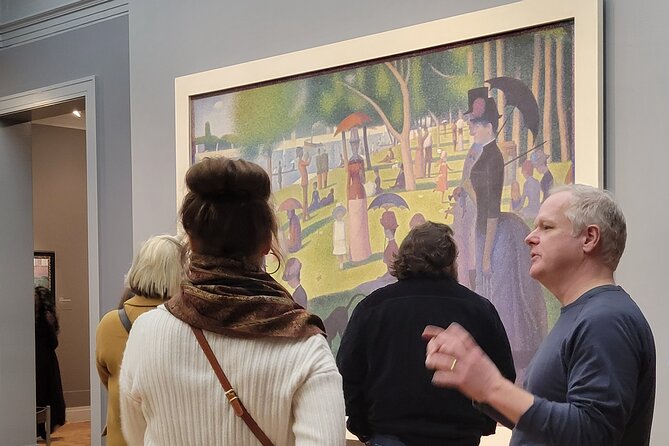
Georges Seurat’s Sunday on La Grande Jatte is one of the museum’s major calling cards. Its carefully arranged figures and tiny touches of color make it a perfect teaching piece for a short guided visit.
You do not need a background in art to follow the basic idea. From a distance, the image reads as a calm park scene. Up close, the surface breaks into calculated marks. A guide can show you how Seurat built the image and why the painting feels both relaxed and highly controlled.
The Art Institute is also known for the strength of its Impressionist and Post-Impressionist holdings. A tour that explains how the museum built that collection adds useful Chicago context to the paintings. You are not simply looking at famous European art. You are also learning why these particular works ended up here and how the museum became such an important home for them.
A completely different way to spend a day nearby:
- Chicago Architecture River Cruise
★ 5.0 · 15,756 reviews - Chicago River 90-Minute Architecture Tour
★ 4.5 · 9,629 reviews - Chicago River: 1.5-Hour Guided Architecture Cruise
★ 4.8 · 8,046 reviews - Chicago: Gangsters and Ghosts Walking Tour
★ 5.0 · 7,155 reviews
Van Gogh’s bedroom and the power of a familiar image
Vincent van Gogh’s The Bedroom is one of the stops most people will recognize. Its plain subject, a modest room, becomes intensely personal through color, perspective, and the artist’s unmistakable handling of paint.
This is a good place to see how a guide’s storytelling can change a familiar work. You may already know the painting from books or reproductions, but the physical object gives you a different sense of its scale and surface. A guide can add background about Van Gogh’s life and artistic aims without turning the stop into a biography lecture.
The route may include several works from different periods and countries, so you should expect each stop to be fairly focused. That is useful for building a broad picture, but it also means you will not get a long, quiet conversation with every painting.
O’Keeffe, Hopper, and the American collection
Georgia O’Keeffe’s Sky Above Clouds shifts the tour toward American modernism. The work’s repeated forms and expansive subject give the guide a chance to discuss scale, abstraction, and the different ways artists use the American landscape and sky.
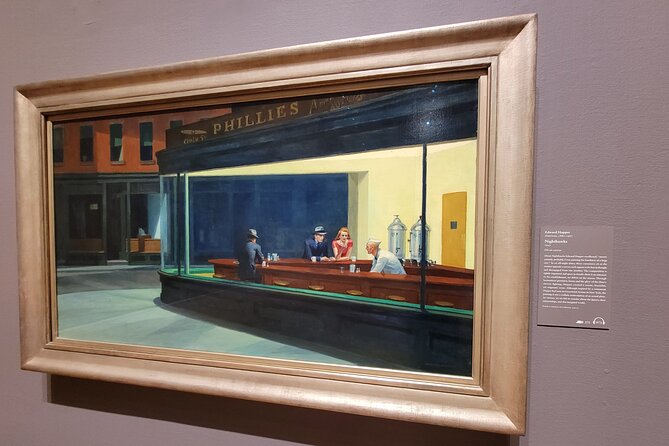
Edward Hopper’s Nighthawks brings a very different kind of mood. Its late-night diner, bright interior, and isolated figures have become part of the visual language of American culture. You can recognize the scene at once, yet the painting leaves plenty of questions about the people inside it.
These two works make a strong pairing because they show how varied American modern art can be. O’Keeffe offers a sense of openness and repetition. Hopper gives you urban quiet and emotional distance. A guide who adds period context can help you see these not just as attractive images but as works shaped by changing ideas about American life.
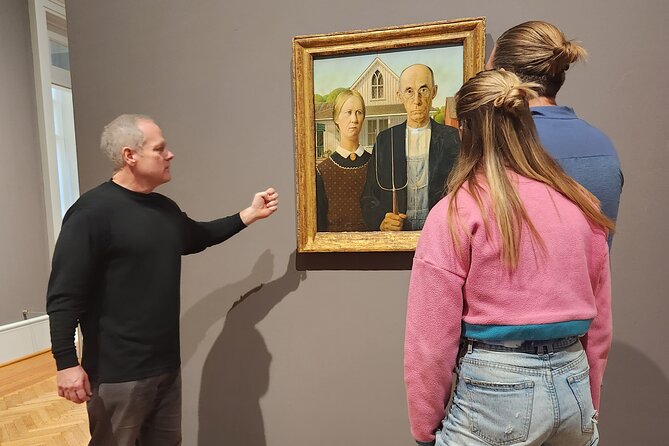
Grant Wood’s American Gothic continues that American thread. The painting’s familiar figures and stern expressions often invite a quick smile, but it rewards a closer look at pose, clothing, setting, and regional identity. A short explanation helps separate the popular image from the choices Wood made as an artist.
A pause for the unsettling Picture of Dorian Gray
Ivan Albright’s A Picture of Dorian Gray is one of the more unusual works on the suggested route. It does not offer the easy beauty of a landscape or the instant familiarity of a Van Gogh. Its distorted figure and detailed surface can be unsettling.
That change of tone is important. A good museum tour should not only run from one pleasant masterpiece to the next. It should show you how artists can use paint to make a viewer uncomfortable, curious, or even resistant.
This stop may appeal especially to you if you like art that raises questions rather than providing a simple visual reward. It also shows the range of the Art Institute’s collection and the guide’s ability to move between well-known icons and less familiar works.
Chagall, Picasso, and the pleasures of visual invention
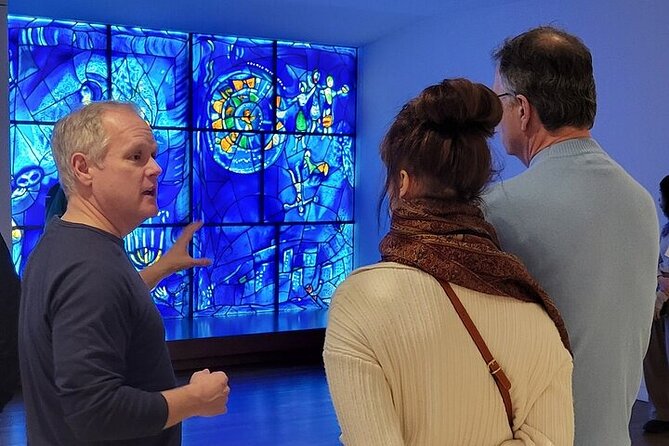
Marc Chagall’s America Windows adds strong color and a large decorative presence to the route. The work can prompt discussion of stained glass, symbolism, and the relationship between art, architecture, and public space.
Pablo Picasso’s The Old Guitarist brings the tour into a more emotionally direct register. Its blue tones and bowed figure are closely tied to Picasso’s Blue Period. Even a short explanation of the artist’s circumstances and stylistic choices can make the painting feel less like a textbook example and more like a human statement.
These stops show why the tour is useful for people who do not consider themselves art experts. You do not need to memorize movements or dates. You need a few strong connections: what the artist was trying to do, what was happening around the work, and what details are worth noticing.
Warhol and Pollock close the modern-art sweep
Andy Warhol’s Four Mona Lisas offers a sharp contrast to the single, revered image associated with Leonardo. Repetition, celebrity, reproduction, and mass culture come into play. The work is easy to grasp at a basic level, but a guide can help you think about why repeating a familiar face changes its meaning.
Jackson Pollock’s Greyed Rainbow provides a different challenge. Pollock’s technique can seem chaotic if you do not know what to look for. A guide can point out the physical act of making the work, the movement across the surface, and the way the title affects your reading of the painting.
Ending with Warhol and Pollock gives the route a broad sweep from European painting to American postwar experimentation. You see how ideas about subject matter, technique, and the role of the artist changed over time.
What the guide adds to the museum visit
The guide is the main reason to book this experience rather than simply buying admission and walking in alone. Several named guides receive especially strong praise for their mix of art knowledge and personality.
Joel is repeatedly described as passionate about both art and Chicago. His approach includes stories about artists, the museum’s collection, and the work involved in building a major institution. Bernie is praised for knowing the museum layout well and moving efficiently between important rooms. Scout is noted for humor, anecdotes, and Chicago connections.
Colleen is praised for helping the group see highlights before crowds arrived, then showing people how to return to rooms afterward. Arnold is described as accommodating and ready to answer questions. Michelle, Robert, Marlin, and other guides are also praised for clear explanations, enthusiasm, and strong storytelling.
The guide assigned to your departure may vary, so you should not book on the assumption that one particular person will lead your tour. Still, the repeated pattern is clear: this is designed as an interpretive tour, not simply a walk through rooms with names and dates.
The pace, group size, and physical effort
The two-and-a-half-hour length sounds moderate, but a museum tour at this pace involves a fair amount of standing and walking. The information recommends a moderate level of physical fitness. I would wear comfortable shoes and avoid scheduling something that requires you to sprint across downtown immediately afterward.
A maximum of 12 people is a meaningful advantage. Small groups make it easier to stay together, hear the guide, and ask about a particular artist. They also reduce the awkward stop-and-start feeling common on larger tours.
The pace remains the main concern. One especially positive assessment still called the tour fast and noted there was not enough time to linger or explore along the way. That is not a flaw if you want an efficient introduction. It is a drawback if you prefer to sit with one painting for 20 minutes.
The best plan is to accept the tour as your first pass. If you have energy and time, return to favorite rooms after the guided portion. Admission is included, and the tour ends back at the meeting point, so you have a clear chance to continue on your own.
Is $71.40 a good value?
At $71.40 per person, this is not the cheapest way into the Art Institute. You are paying for admission, a skip-the-line format, a two-and-a-half-hour guide, and a small group rather than just a museum ticket.
I see the strongest value if you have limited time in Chicago, feel unsure about modern art, or want to understand the museum’s layout before exploring alone. The cost can also make sense for a first visit when the alternative is spending several hours wandering past major works without knowing what you are seeing.
The value is weaker if you already know the collection well or want total freedom. You will follow the guide’s route, and the schedule leaves limited room for personal detours. At the same time, the high recommendation rate and 5 out of 5 rating across 417 reviews suggest that the format works very well for its intended audience.
This experience is booked an average of 20 days ahead, so popular dates may fill early. Free cancellation is available until 24 hours before the start time. Within 24 hours, the payment is not refunded and changes are not accepted.
Who should book the 10:30 am tour?
I would choose this tour for a first-time visitor to the Art Institute, a family that wants structure, a solo visitor who likes asking questions, or a couple trying to fit a major museum into a busy Chicago itinerary.
It also suits anyone who wants art history explained in plain language. You will hear about artists’ lives, periods, methods, and the museum’s collecting story without needing prior study.
I would hesitate if your main goal is slow looking. You might prefer a self-guided visit if you already have a short list of paintings, want to focus on one period, or dislike moving with a group.
The museum is near public transportation, and service animals are allowed. The meeting point is the Art Institute itself at 111 S Michigan Ave. A mobile ticket is provided, and the tour is offered in English.
Should you book the Art Institute guided tour?
Book it if you want a well-planned introduction to one of Chicago’s great museums and would rather spend your time looking at major works than finding them. The small group, included admission, and guide-led route make the experience especially useful on a short Chicago visit.
Go in expecting a brisk survey, not a private conversation with every painting. My best advice is to treat the tour as your orientation, note the rooms and works you want to revisit, then stay afterward if your schedule allows. For most first-time visitors, that combination offers a much better start than wandering in cold.
FAQ
Where does the tour begin?
The tour begins at the Art Institute of Chicago, located at 111 S Michigan Ave, Chicago, Illinois 60603.
What time does the tour start?
The scheduled start time is 10:30 am.
How long does the tour last?
The tour lasts approximately two hours and 30 minutes.
Is museum admission included?
Yes. All admission fees are included in the tour price.
How large is the tour group?
The group has a maximum of 12 travelers.
Is the tour offered in English?
Yes. The tour is offered in English.
Is the ticket mobile?
Yes. A mobile ticket is provided.
Does the tour include skip-the-line entry?
Yes. The experience is described as a skip-the-line semi-private guided museum tour.
Where does the tour end?
The activity ends back at the Art Institute of Chicago meeting point.
Can I cancel for a full refund?
Yes. You can cancel at least 24 hours before the experience start time for a full refund. Cancellations or changes made less than 24 hours before the start time are not accepted for a refund.
Recently reviewed around Chicago
- Delicious Donuts & City Sights: Chicago’s Original Donut Tour★ 5.0 · 1,389 reviews
- Field Museum of Natural History Admission Tickets★ 4.5 · 489 reviews
- City Cruises Chicago: Signature Lunch Cruise on Lake Michigan★ 4.0 · 348 reviews
- Bikes, Bites & Views: Chicago’s Signature Dishes Bike Tour-Adults★ 5.0 · 732 reviews
- Original Chicago Architecture Interiors Tour: Dazzling Interiors★ 5.0 · 1,489 reviews
- BYOB Spray Paint and Sip at Studio W.I.P.★ 5.0 · 401 reviews
- Chicago Architecture Tour: Underground Pedway and the Loop★ 5.0 · 388 reviews
- Chicago Loop District Food Tour with Deep Dish & Beef Sandwich★ 5.0 · 870 reviews
Skip the Line, compared.


Circle Line 1-Hr Statue of Liberty Skip-The-Line Cruise
Read our review →

Statue of Liberty Sunset Cruise Skip-the-Line Ticket
Read our review →
Skip-the-Line Escape from The Rock Bay Cruise
Read our review →
Skip the Line: Express Ticket at Universal Studios Hollywood
Read our review →

LA: Aquarium of the Pacific Skip-the-Line Entry
Read our review →Browse the lists this tour appears in