
Reviewed · NEW YORK CITY TOURS
Brooklyn Bridge & DUMBO Neighborhood Tour – from Manhattan to Brooklyn
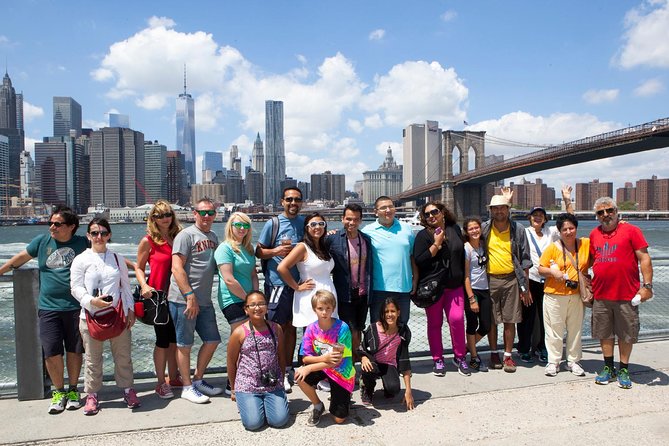
The best part of this Brooklyn Bridge and DUMBO tour is the way it turns a famous walk into a connected New York story. You begin among Lower Manhattan’s civic buildings, cross the 1.1-mile bridge while learning how it was built, then arrive in a former warehouse district now filled with galleries, restaurants, and waterfront views.
I like the clear route and the useful local knowledge. The guide keeps the group moving from Tweed Courthouse to Brooklyn, while planned stops give you time for questions and photos. I also like that the tour ends at Brooklyn Bridge Park, where you can continue exploring or sit down for lunch in DUMBO. The main drawback is group size, which can reach 30 people. Some stops may feel slow while everyone gathers.
In This Review
- Key points to know
- A two-hour walk from City Hall to Brooklyn Bridge Park
- Tweed Courthouse and the civic heart of Lower Manhattan
- The Municipal Building adds scale and city politics
- Crossing the 1.1-mile Brooklyn Bridge
- What makes the bridge walk physically demanding
- Arriving in DUMBO, Brooklyn’s former warehouse district
- Brooklyn Bridge Park and the best skyline finish
- The guide makes the difference
- How the $49 price measures up
- Who should book this Brooklyn walk
- Practical details before you go
- Should you book the Brooklyn Bridge and DUMBO tour?
- FAQ
- Where does the Brooklyn Bridge and DUMBO tour start?
- What time does the tour begin?
- Where does the tour finish?
- How long is the experience?
- How far do you walk across the Brooklyn Bridge?
- Is admission to the Brooklyn Bridge included?
- What happens if I need to cancel?
Key points to know
- A one-way New York walk: You start near City Hall in Manhattan and finish in Brooklyn, so you do not retrace your steps.
- Bridge history with a human side: Expect stories about the bridge’s design, construction problems, and the people behind the project.
- Strong views for your camera: The walk includes sightlines toward the Statue of Liberty, Empire State Building, Chrysler Building, Ellis Island, and Verrazano-Narrows Bridge.
- DUMBO beyond the photo stop: You get time for galleries, shops, converted warehouses, cafes, and the neighborhood’s performance scene.
- A useful end point: Brooklyn Bridge Park offers skyline views and puts you near lunch options in DUMBO.
- A moderately active outing: The route takes about two and a half hours and includes a bridge crossing, standing, and walking on city streets.
A two-hour walk from City Hall to Brooklyn Bridge Park
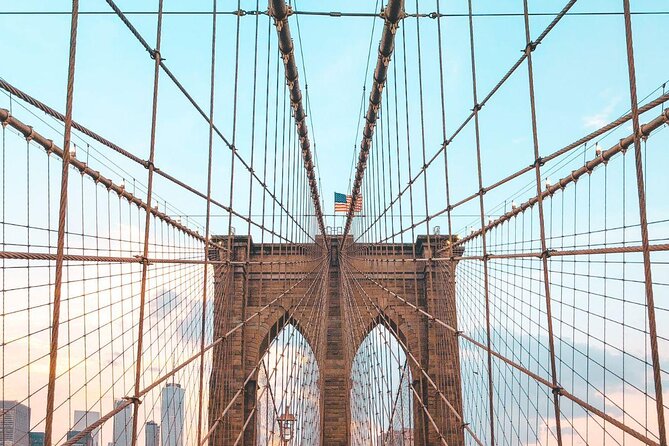
At $49 per person, this is not the cheapest way to cross the Brooklyn Bridge. You can walk the bridge for free on your own. The value comes from the interpretation: a guide explains what you are seeing, adds civic and neighborhood context, and takes care of the route.
The experience lasts about two hours and 30 minutes, with an 11:00 a.m. start. That timing makes it easy to use the tour as the first half of a day in Brooklyn. Once you finish at Brooklyn Bridge Park, you can stop for lunch, explore DUMBO, or continue along the waterfront.
The tour is offered in English and uses a mobile ticket. It is capped at 30 people, though some past groups have numbered around 24 or 25. That is manageable, but not intimate. If you prefer a small group where every question gets plenty of attention, this format may feel a little broad.
Other New York City days travellers line up against this one:
- NYC: SUMMIT One Vanderbilt Tickets
★ 4.7 · 51,195 reviews - NYC: 9/11 Memorial & Museum Timed-Entry Ticket
★ 4.8 · 31,428 reviews - NYC: Empire State Building Tickets – Observatory & Museum
★ 4.7 · 25,757 reviews
Tweed Courthouse and the civic heart of Lower Manhattan
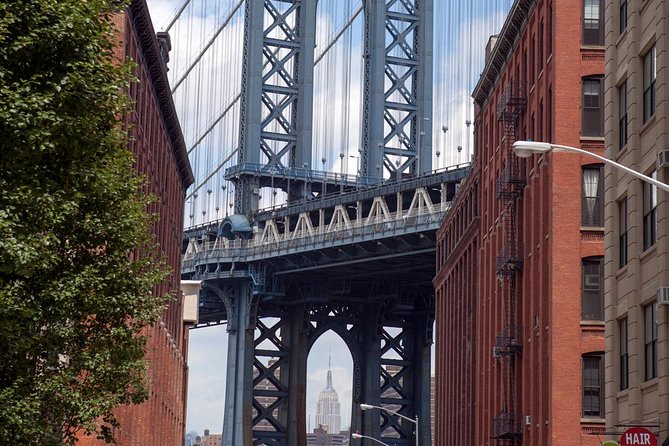
Meet in front of Tweed Courthouse at 52 Chambers Street. The building is worth a look before the tour even begins. Completed in 1881, it represents the grand public architecture of 19th-century New York, along with the political corruption tied to its construction.
You visit the courthouse exterior for about 10 minutes. Do not expect to go inside, since admission is not included. The stop works mainly as an introduction to New York’s civic past and to the city blocks around City Hall.
From here, the guide leads you toward the bridge and talks about Brooklyn’s place in New York history. This opening section helps you see the bridge as more than a postcard view. It was built to connect two cities at a time when Brooklyn was still separate from Manhattan.
The Municipal Building adds scale and city politics
The next stop is the Municipal Building, another large civic structure near the starting point. You spend about 10 minutes outside, hearing about the building and the public statue located there, described as the second-largest public statue in New York City.
This is a short stop, but it gives the walk a useful rhythm. Instead of rushing directly to the bridge, you get a look at the government center of Lower Manhattan. The route also passes other City Hall area sights, so you begin with architecture and public life before shifting to engineering.
The guide is an important part of this section. Past tours have included Sean, Kevin, Tom, Rori, Liam, Ludie, Charles, Marcos, Russell, and others. Their styles differ, but the strongest feedback consistently points to clear explanations, humor, and a good command of both historical facts and current Brooklyn life. Sean, who has been described as a history professor and Brooklyn resident, received particular praise for connecting the past with local recommendations.
Crossing the 1.1-mile Brooklyn Bridge
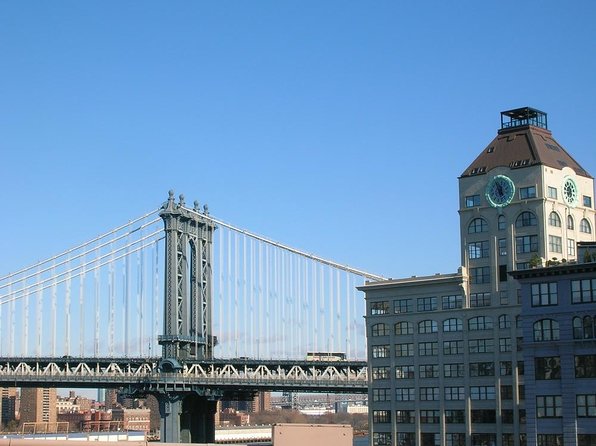
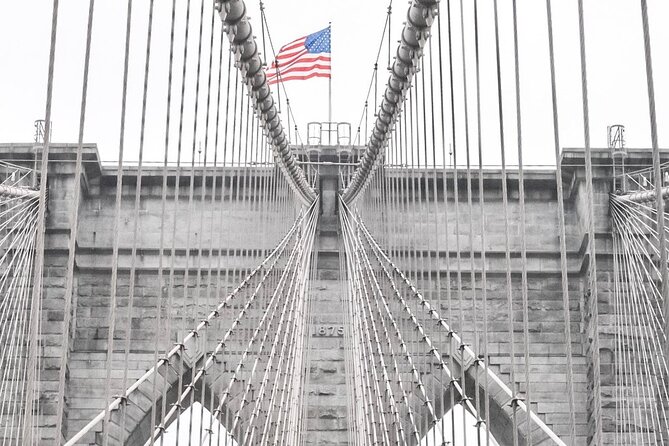
The main event is the walk across the Brooklyn Bridge. The crossing itself takes about 50 minutes, including stops for explanation and photographs. The bridge opened in 1883 and was the longest suspension bridge in the world when it was built. It is also known for its early use of steel wire and its hybrid design, combining suspension and cable-stayed elements.
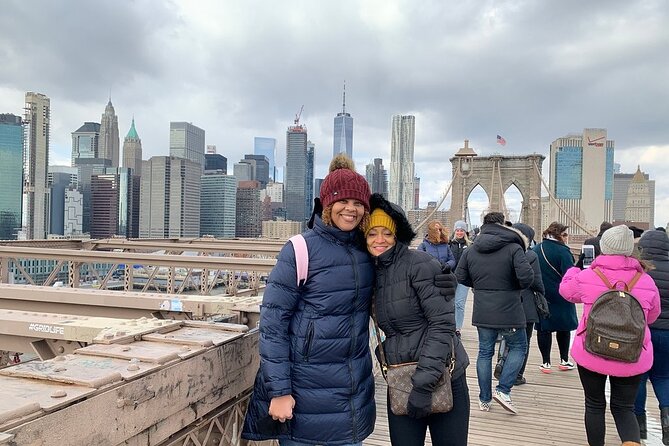
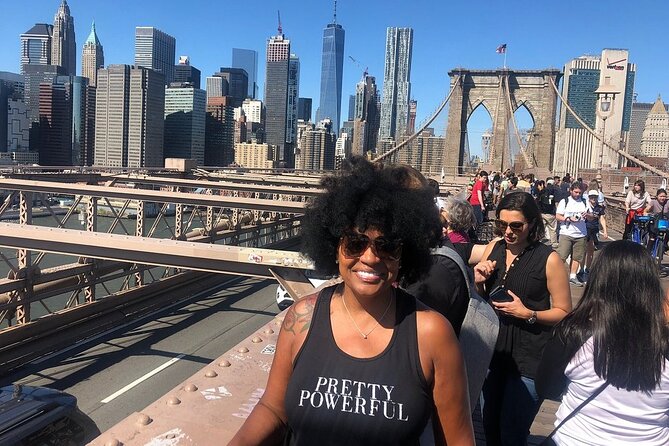
You walk on the elevated pedestrian promenade, with road traffic below and the bridge’s stone towers and cables around you. The views change as you move. Looking back, you see Lower Manhattan and the Empire State Building. From other points, you may see the Statue of Liberty, Ellis Island, the Chrysler Building, and the Verrazano-Narrows Bridge.
A guide adds something you would likely miss alone. The tour covers the bridge’s design, construction challenges, and the practical problems faced during the work. You hear about the effort required to build a structure of this size in the 19th century, rather than simply stopping for the standard Manhattan skyline photograph.
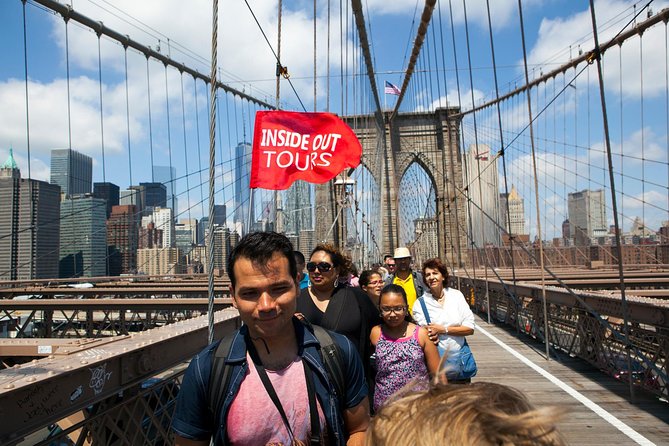
The pace is not a nonstop march. The group pauses at selected places so the guide can speak, answer questions, and let you take pictures. That is helpful for families and first-time visitors. It also means you should expect periods of standing while the group gathers.
This is the chief point of balance. A group of 25 or more can spread out on a busy bridge promenade. The guide may pause several times to bring everyone together, and one past participant found the waiting frustrating. The tour operator’s approach is clearly to keep the group intact and avoid leaving anyone behind. That is considerate, but it can make the crossing feel longer than 50 minutes.
Bring patience, especially on a crowded day. The bridge is a public walkway, not a private tour route, so you will share it with pedestrians, cyclists, and other sightseeing groups. The guide’s instructions about meeting points are useful if the group becomes separated.
A completely different way to spend a day nearby:
- NYC: Empire State Building Observation Deck Tickets
★ 4.7 · 22,072 reviews - NYC: Edge Observation Deck Admission Ticket
★ 4.6 · 20,918 reviews - New York City: Statue of Liberty & Ellis Island with Ferry
★ 4.6 · 18,683 reviews - New York City: American Museum of Natural History Ticket
★ 4.5 · 15,447 reviews
What makes the bridge walk physically demanding
This is a moderate walking tour, not a hard hike. Still, you will be on your feet for much of the 2.5 hours, and there is limited opportunity to sit. One person noted only a single place to sit during the walk. A public restroom stop is included near the end, and it may take time because the full group needs to gather.
That pause can be useful for families, older adults, and anyone who needs a break. It can also feel excessive if you are eager to keep moving. Wear comfortable shoes and check the weather closely. The bridge is exposed, and a January tour was described as enjoyable but very cold. A sunny day makes a real difference.
The tour allows service animals and is near public transportation. The supplied details do not promise a fully accessible route or specify accommodations for every mobility need, so anyone with walking concerns should check the route before booking. The safest assumption is that you need to manage a sustained urban walk with standing and bridge traffic.
Arriving in DUMBO, Brooklyn’s former warehouse district
After crossing the bridge, the tour moves into DUMBO, whose name means Down Under the Manhattan Bridge Overpass. The neighborhood sits between the Manhattan and Brooklyn bridges and is known for cobblestone streets, converted warehouse buildings, waterfront access, restaurants, cafes, galleries, and performance spaces.
You spend about 30 minutes exploring the area. This is less a formal museum visit than a guided orientation to the neighborhood. The guide points out the character of the old industrial buildings and explains how DUMBO became one of New York’s better-known arts districts.
The route includes the area around galleries and venues such as Klompching Gallery, St Ann’s Warehouse, and A.I.R. Gallery. Admission to attractions is not included, and the tour does not promise interior visits. Think of this portion as a useful introduction that helps you decide where to return later.
DUMBO is also the practical reward at the end of the bridge walk. The neighborhood has plenty of places to eat, and guides such as Sean and Tom have offered onward directions and restaurant suggestions. Several tour experiences ended with lunch in DUMBO, which makes the late-morning schedule especially convenient.
Brooklyn Bridge Park and the best skyline finish
The tour ends at Brooklyn Bridge Park, an 85-acre waterfront park at 2 Furman Street. The park has lawns, planted areas, family activities, and broad views across the East River toward Manhattan.
This is a strong finishing point because you are not deposited beside a subway entrance and left to figure out the neighborhood. You can pause for more skyline photographs, find lunch nearby, or use the park as the next part of your day. The end point also gives you a chance to slow down after the bridge crossing.
The park is especially useful if your group has mixed interests. Children can enjoy the open space and family activities, while adults can continue toward restaurants, shops, and galleries. The tour itself ends here, so any additional exploration is on your own.
The guide makes the difference
The strongest feature of this experience is the quality of the guiding. The tour is built around stories, not just directions. Guides have been praised for explaining the bridge clearly, answering questions, adding humor, and giving practical suggestions for food and onward plans.
Kevin has been singled out for handling unexpected questions with an authentic New York manner. Tom received credit for arriving early, explaining what to do if the group became separated, scheduling a restroom break, and offering directions at the end. Rori was described as enthusiastic and delightful, while Liam’s energy helped bring the bridge story to life.
That range matters because a walking tour depends heavily on the person leading it. The provider is Inside Out Tours LLC, but you should not assume a specific guide unless your booking confirms one. The experience can be excellent with a strong storyteller, while a less energetic guide could make the standing portions feel longer.
The guide also controls the balance between instruction and movement. The best version of this tour gives you enough background to understand the bridge without turning every stop into a lecture. The high overall rating of 4.9 from 826 reviews and a 97 percent recommendation rate suggest that the format works well for most people, though the group-size concern is worth keeping in mind.
How the $49 price measures up
At $49, you are paying for a guided introduction rather than access to a paid attraction. There is no bridge admission charge, and the courthouse, Municipal Building, DUMBO streets, and Brooklyn Bridge Park are viewed from the outside or in public space.
I think the price makes sense if you want context and a ready-made route. A guide can explain why the bridge mattered, point out distant landmarks, keep the walk organized, and help you understand DUMBO before you spend the rest of the day there.
The value is weaker if you mainly want photographs or already know the bridge and neighborhood well. You can cross independently for free and explore DUMBO at your own pace. The tour earns its cost through the stories and local orientation, not through exclusive entry or special transport.
The experience is also a good use of time during a short New York visit. In one outing, you cover a civic district, an iconic bridge, a Brooklyn arts neighborhood, and a waterfront park. You do not need to plan separate routes or research every landmark before arriving.
Who should book this Brooklyn walk
This tour suits first-time New York visitors who want a clear introduction to the bridge and DUMBO. It also works for families, couples, solo visitors, and returning New Yorkers who enjoy urban history and local stories. One review specifically described it as worthwhile even for someone familiar with New York.
You should be comfortable walking for several hours, standing during talks, and keeping up with a group. It is not ideal for someone who wants a slow, private stroll with long breaks. The route can move at a brisk pace, and crowded bridge conditions may require patience.
For families, the mix is useful. The bridge supplies the big spectacle, the stories provide structure, and Brooklyn Bridge Park gives children space at the end. For couples and solo visitors, the tour removes the awkwardness of figuring out the best viewpoint while also providing ideas for lunch afterward.
Book this if you want to learn as you walk. Skip it if you only need a bridge crossing and prefer to make every stop on your own timetable.
Practical details before you go
The meeting point is in front of Tweed Courthouse, 52 Chambers Street, New York, near public transportation. The tour begins at 11:00 a.m. and finishes at Brooklyn Bridge Park, 2 Furman Street, Brooklyn.
The booking confirmation is provided at the time of purchase. The experience is offered in English, uses a mobile ticket, and allows service animals. It requires a minimum number of participants, so a cancellation for that reason brings the choice of another date or experience, or a full refund.
Free cancellation is available up to 24 hours before the start time. Cancel at least 24 hours ahead for a full refund. Inside that window, changes are not accepted and the payment is not refunded. Cutoff times use New York local time.
The tour is often booked about 30 days ahead, so reserve early if your schedule is fixed. Choose clothing for the forecast, wear reliable walking shoes, and leave room in your day for lunch or further exploring in DUMBO.
Should you book the Brooklyn Bridge and DUMBO tour?
Book it if you want more than a famous view. The tour gives you a well-planned crossing, a useful lesson in bridge construction, a look at Lower Manhattan’s civic center, and a short introduction to DUMBO’s galleries, shops, and food scene.
I especially recommend it for first-time visitors and families who prefer a guide to handle the route. The biggest caution is the group format. With up to 30 people, you may wait while everyone catches up, and the bridge can feel crowded.
At $49, the tour is a fair purchase for its storytelling and local guidance. It is not necessary for independent walkers, but it is a practical way to connect several major New York sights in one morning and finish exactly where you want to spend the afternoon.
FAQ
Where does the Brooklyn Bridge and DUMBO tour start?
The tour starts in front of Tweed Courthouse at 52 Chambers Street, New York, near public transportation.
What time does the tour begin?
The scheduled start time is 11:00 a.m.
Where does the tour finish?
The tour ends at Brooklyn Bridge Park at 2 Furman Street in Brooklyn.
How long is the experience?
The tour lasts approximately two hours and 30 minutes.
How far do you walk across the Brooklyn Bridge?
The Brooklyn Bridge crossing is about 1.1 miles, or 1.8 kilometers. The full experience also includes walking in Lower Manhattan, DUMBO, and Brooklyn Bridge Park.
Is admission to the Brooklyn Bridge included?
There is no admission ticket required for the bridge crossing. The tour includes a local guide and the guided walk across the bridge, but admission to any galleries or other attractions is not included.
What happens if I need to cancel?
You can receive a full refund if you cancel at least 24 hours before the experience starts. Cancellations or changes made within 24 hours are not refunded or accepted.
Recently reviewed around New York City
- Dyker Heights Christmas Lights Guided Tour★ 4.5 · 920 reviews
- New York City Dinner Cruise with Live Music★ 4.0 · 377 reviews
- New York City Holiday Lights Tour★ 4.5 · 664 reviews
- NYC in a Day Tour: Statue of Liberty, Times Square and More★ 5.0 · 366 reviews
- Broadway and Times Square Insider Tour with Theater Professional★ 5.0 · 651 reviews
- NYC Central Park Bicycle Rentals★ 4.5 · 368 reviews
- Central Park Bike Rental New York City★ 4.0 · 560 reviews
- Museum of Ice Cream New York City Admission Ticket★ 4.0 · 1,154 reviews
New York City Tours, compared.
Empire State Building Tickets – Observatory & Museum
Read our review →
Empire State Building Observation Deck Tickets
Read our review →

Browse the lists this tour appears in