
Reviewed · MUSEUMS
Miami: Frost Museum of Science and Planetarium Entry Ticket
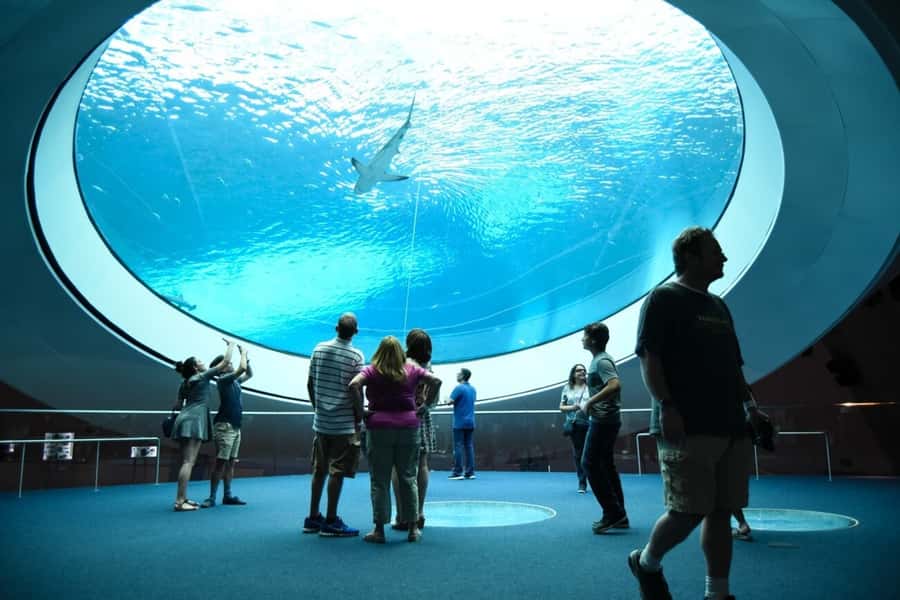
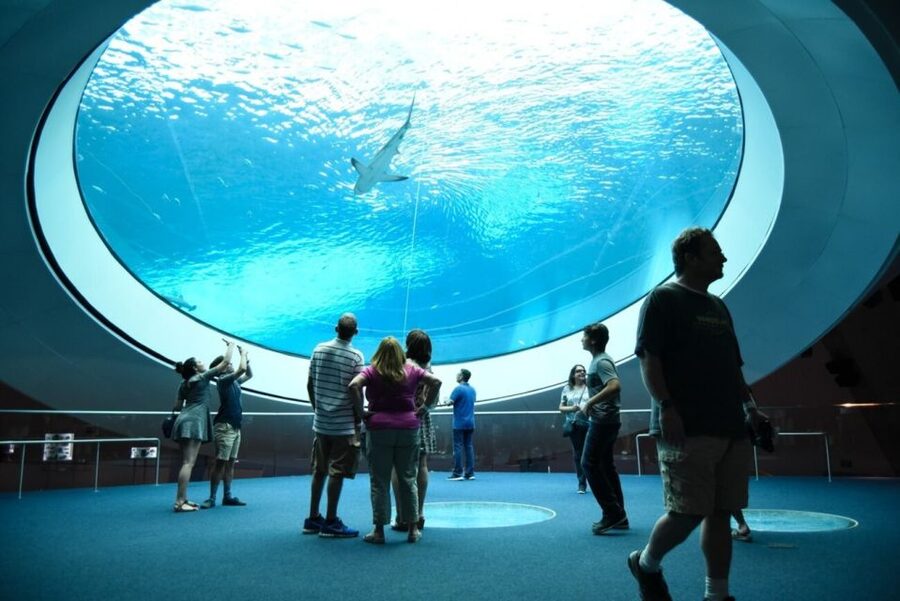
Miami’s Frost Science Museum brings together three big attractions under one roof: a three-level aquarium, hands-on science exhibits, and Miami’s only planetarium. I especially like the chance to touch a stingray and watch hammerhead sharks glide through the water, then shift from ocean life to space travel without changing venues.
I also like the museum’s range. Young children can watch jellyfish and explore oversized bugs, while older children and adults can test science gadgets, study aviation, and land a spacecraft on Mars. The main drawback is simple: $30 is a fair price only if you stay for several hours, and the planetarium show is first come, first served.
In This Review
- Key points to know before you go
- Start with the aquarium’s three levels
- Make time for the bugs and the hands-on science
- Meet a 30-foot dinosaur on the way to space
- Choose your planetarium show carefully
- The Power of Science adds context
- Give yourself three to four hours
- Is $30 good value?
- Who will enjoy Frost Science most?
- My practical verdict
- FAQ
- How long should I plan to spend at Frost Science?
- Does the ticket include the aquarium?
- Is a planetarium show included?
- Can I choose any planetarium show when I arrive?
- Can I touch a stingray?
- Is the museum wheelchair accessible?
Key points to know before you go
- The aquarium is the museum’s visual star: Expect three levels of sea life, with stingrays, jellyfish, and hammerhead sharks among the main attractions.
- The planetarium includes one show: Choose between Dynamic Earth, narrated by Liam Neeson, and Black Holes, a trip through galaxies, wormholes, and stellar collapse.
- Plan on three to four hours: You can move quickly, but the museum rewards a slower pace, especially with children.
- The exhibits suit mixed ages: Bugs, dinosaurs, interactive science stations, and space displays give each age group something to do.
- Planetarium seats are not guaranteed: Shows are available on a first-come, first-served basis, so do not leave the theater until the last minute.
- The ticket is wheelchair accessible and includes skip-the-line entry: Food, drinks, transport, and annual membership upgrades cost extra or are not included.
Start with the aquarium’s three levels
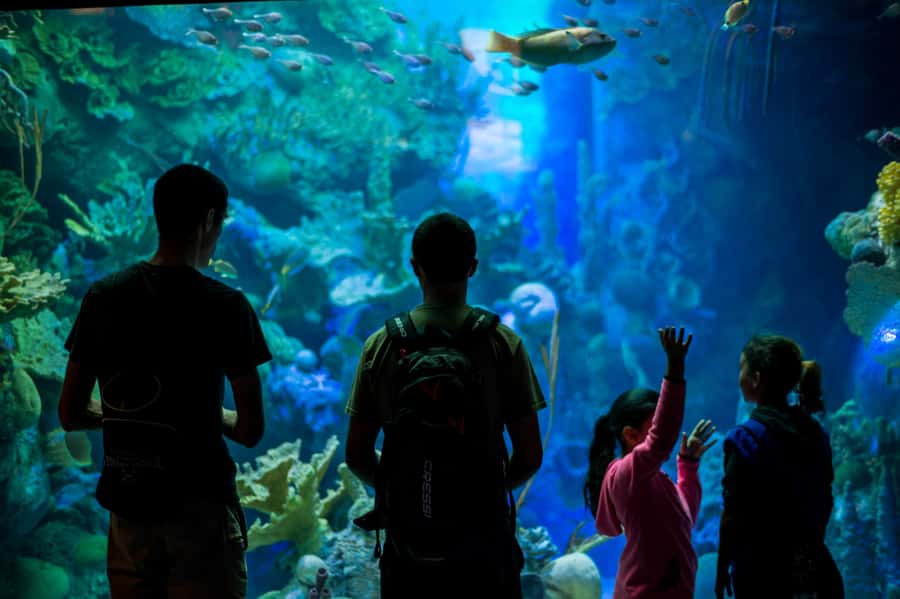
I would begin with the aquarium. It gives you the clearest sense of the museum’s scale, and its downward route creates a satisfying change of pace as you move through different underwater settings.
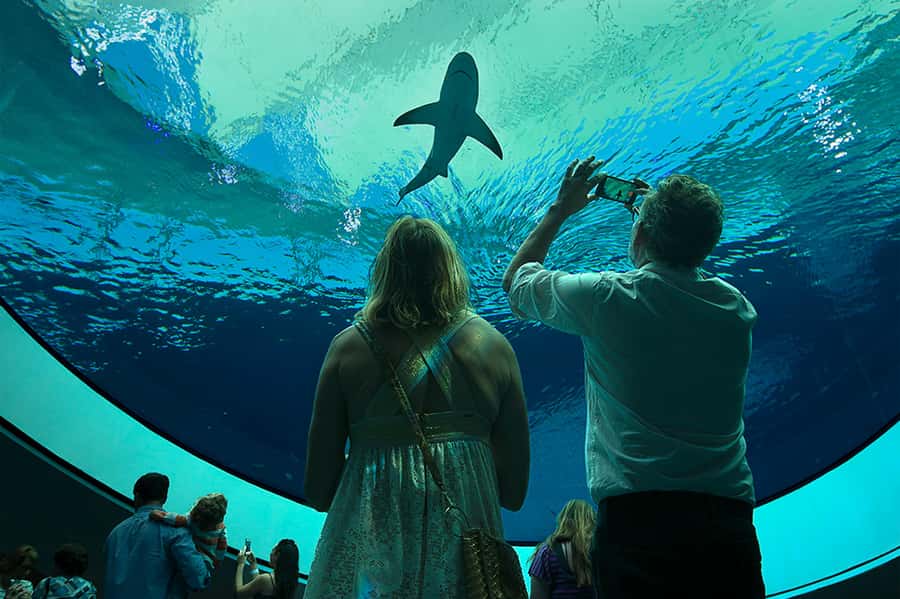
The aquarium is not just a room with tanks along the walls. You descend through three levels, with the displays arranged to make the water world feel larger as you go. You might first notice the color and movement of smaller fish, then pause for the jellyfish, whose slow motion offers a quiet break from the busier interactive exhibits.
The hammerhead sharks are one of the strongest sights. Their unusual head shape makes them easy to identify, and seeing them move through the water gives children a useful connection between the animal’s appearance and its way of life. I would give this area time instead of treating it as a quick walk-through.
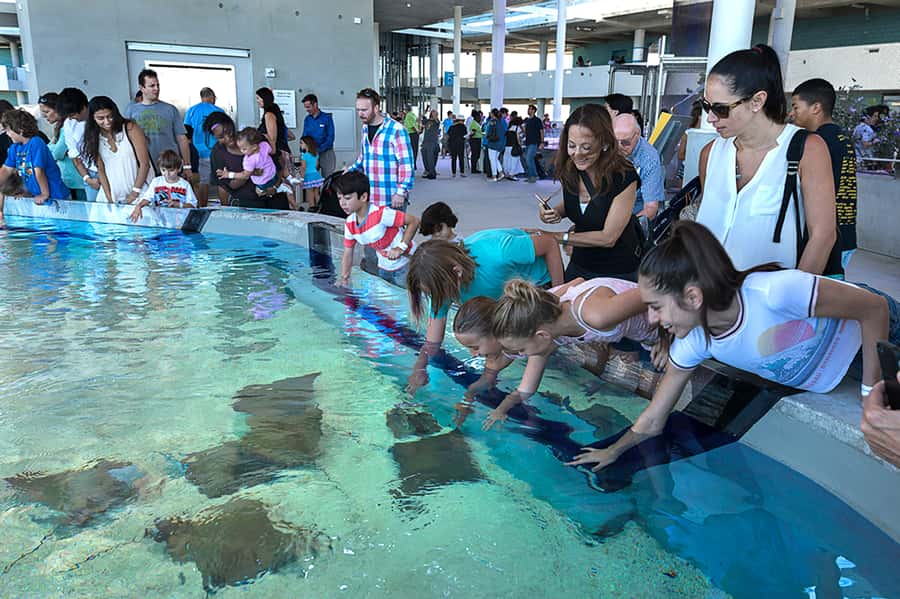
The stingray area adds a hands-on moment. You may touch a stingray, which turns an animal normally seen behind glass into something you can understand through texture and movement. The experience is especially useful for younger children who are not yet ready to read long explanations but can remember what an animal felt like.
Allow time for the whole aquarium rather than racing toward the planetarium. The aquarium is one of the parts most likely to hold a young child’s attention, since there is constant movement in the water and plenty to point out. It also gives adults an easy way to take a breather while children watch the fish.
More Miami museums and collections:
- Miami: Museum of Ice Cream Entry Ticket
★ 4.3 · 394 reviews - NYC: 9/11 Memorial & Museum Timed-Entry Ticket
★ 4.8 · 31,428 reviews - NYC: Empire State Building Tickets – Observatory & Museum
★ 4.7 · 25,757 reviews
Make time for the bugs and the hands-on science
The museum’s insect displays are easy to underestimate. I would not skip them, especially if you are visiting with children. The bug section includes enlarged close-up views that make color, wings, legs, and body patterns much easier to study than they are in ordinary life.
This is the sort of exhibit that works for both the curious child and the person who normally backs away from insects. The large-scale presentation lets you notice details without needing to stand close to a real bug. It can also turn a quick visit into a useful lesson about form and adaptation.
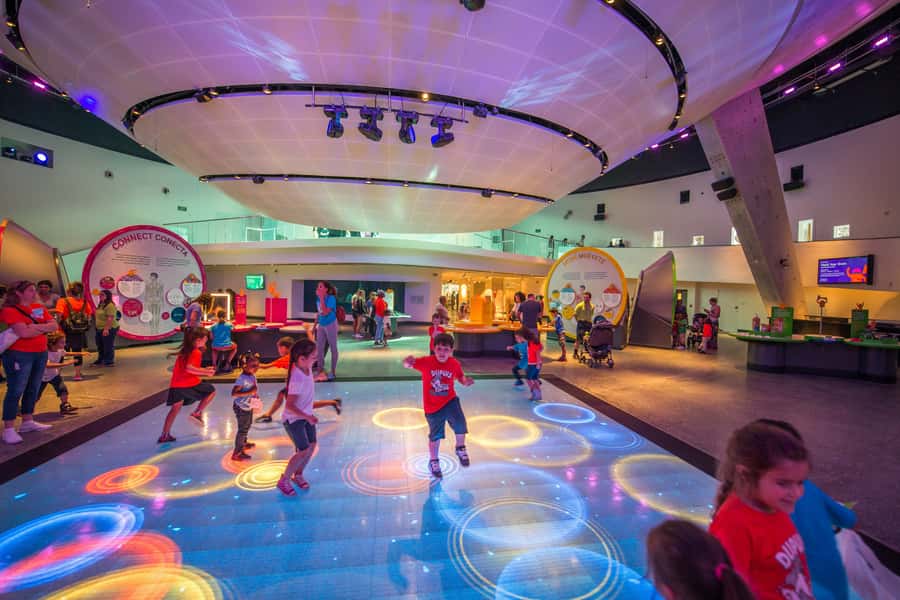
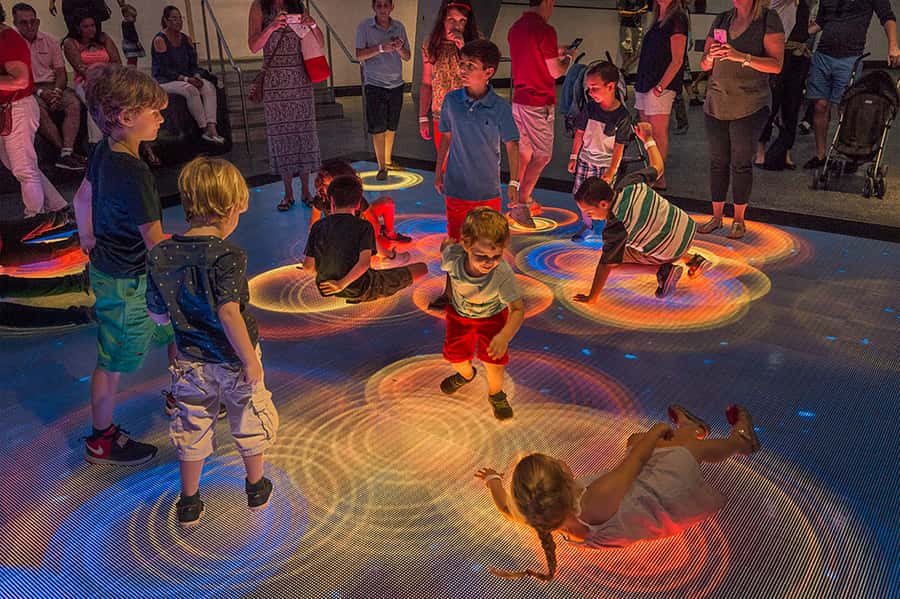
The hands-on science section gives the museum its practical edge. Rather than asking you to admire objects from behind a barrier, it lets you test ideas with science gadgets and interactive stations. These displays are a good choice when children need to move, touch, and try something instead of simply listening.
I like the mix of serious science and playful presentation. You can spend several minutes on one device, move to a completely different experiment, then stop for a display that explains how a scientific idea affects everyday life. The museum does not require you to follow one strict route, so you can adjust the pace to suit your group.
Parents should expect the museum to work better when children are allowed to choose a few exhibits that catch their attention. Trying to cover every station can make the visit feel rushed. Pick several favorites, then keep moving when interest fades.
Meet a 30-foot dinosaur on the way to space
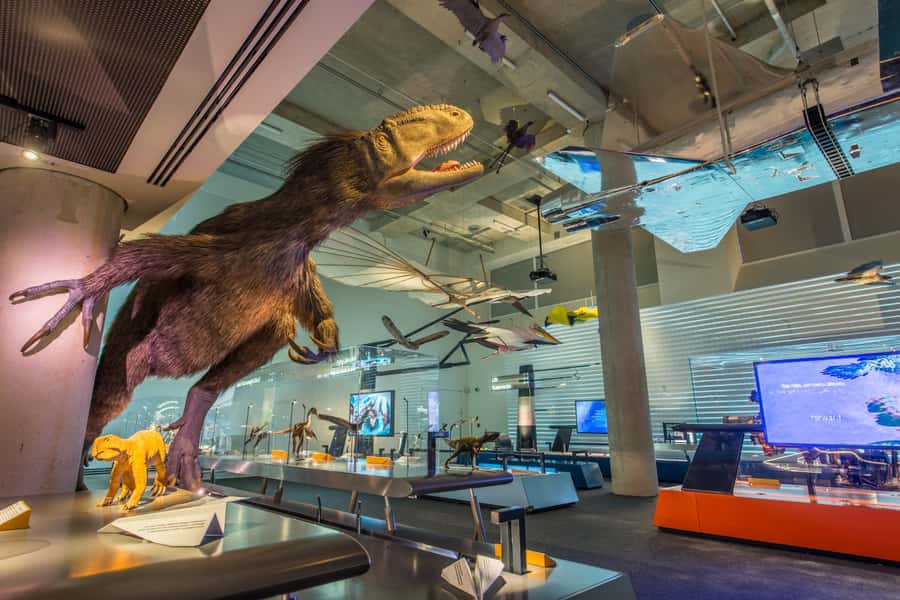
The Feathers to the Stars exhibit connects prehistoric life with human space travel. Its central idea is memorable: the story moves from feathered dinosaurs to aviation and then onward to spacecraft.
The 30-foot Yutyrannus Huali makes an immediate impression. Its size gives children a clear sense of how large some dinosaurs were, while the feathered appearance helps correct the old image of every dinosaur as a scaly monster. You do not need a long attention span to appreciate this display. The scale does the work quickly.
From there, the exhibit turns toward the inventors who pushed aviation forward. This section gives you a useful link between natural history and human invention. You are not just looking at an ancient animal and then jumping to rockets. You are following a broad question: how did life and human curiosity lead toward flight and space travel?
The Mars activity is particularly good for children who enjoy controls and challenges. You can try to land a spacecraft on Mars, which turns space science into a task with a clear goal. Even if you only make one attempt, the activity gives the subject more urgency than a standard wall panel.
I would save this area for children who are beginning to ask how machines work or why space missions are difficult. Younger children may care most about the dinosaur, while older children can spend more time with the aviation and Mars sections.
Choose your planetarium show carefully
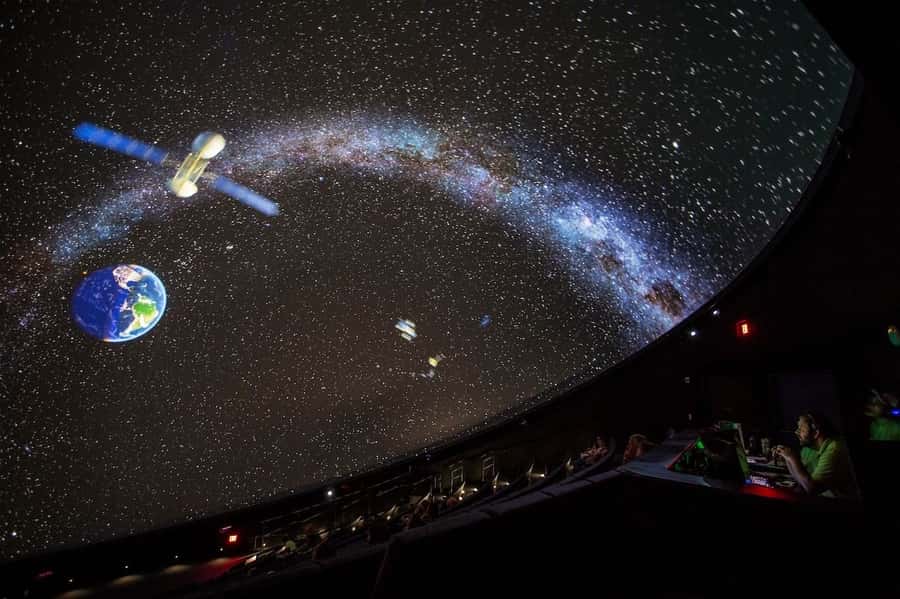
The Frost Planetarium is nearly 360 degrees, so the theater surrounds you with the image rather than placing the action on a small flat screen. That design matters here. It makes the planetarium feel like a change of world, especially during scenes involving space, Earth systems, or the birth and death of stars.
Your ticket includes one show. The available choices described here are Dynamic Earth and Black Holes, so check the current schedule and show availability before you settle in.
Dynamic Earth looks at the inner workings of Earth’s climate system and is narrated by Liam Neeson. I would choose this show if you want a stronger connection to the planet beneath your feet. It is likely the better fit for children who enjoy Earth science, weather, or big questions about how the climate system works.
Black Holes takes you farther from home. You travel through other-worldly wormholes, watch the creation of the Milky Way Galaxy, and see the violent death of a star followed by the birth of a black hole. Choose this one if your group is more interested in galaxies, space-time, and dramatic cosmic events.
The planetarium is one of the museum’s most memorable attractions, but it requires planning. Seats are first come, first served. I would check the show time as soon as you enter, then arrange the rest of your visit around it. Do not assume that a planetarium seat will be waiting whenever you arrive.
One practical point is worth noting: the ticket information can display a time that causes confusion, while the museum ticket may be used when you arrive during the valid day. If the time shown on your confirmation seems unclear, check the details before setting out. The important planning issue inside the museum is still the show schedule and its first-come seating.
More Miami trips worth a second look
- Miami: ‘Superblue Miami’ Immersive Art Experience Ticket
★ 4.4 · 1,247 reviews - Miami: Wynwood Walls Skip-the-Line Ticket
★ 4.6 · 840 reviews - Skip the Line: Wynwood Walls Admission Ticket
★ 4.5 · 368 reviews - Miami: Superblue Miami Immersive Art Experience Ticket
★ 4.0 · 367 reviews
The Power of Science adds context
The Power of Science section looks at how scientific discoveries push beyond what seems possible. It is a useful counterweight to the aquarium and dinosaur displays, because it asks you to think about the people and ideas behind the technology.
I like this kind of exhibit when it gives you a reason to connect separate parts of the museum. After seeing aviation pioneers and a Mars landing activity, you can better understand science as a process of testing, failure, correction, and persistence. The subject becomes less about memorizing names and more about asking what problem someone was trying to solve.
You may find that this section works best for older children and adults. Younger children can still enjoy the interactive parts, but the ideas may matter more to someone who is already interested in engineering or invention.
The museum’s large size helps here. With more than 250,000 square feet of exhibit space, you have room to choose your level of interest. You can spend a few minutes at a display and keep moving, or stay longer when a topic catches you.
Give yourself three to four hours
The most practical advice I can give is to protect a half day for Frost Science. You can enter for a shorter visit, but you will likely feel hurried if you try to see the aquarium, planetarium, dinosaurs, bugs, and interactive galleries in under two hours.
A three to four hour visit gives you time to do the following without racing:
- Check the planetarium schedule and reserve your place in line.
- Walk through the aquarium’s three levels.
- Touch a stingray and watch the jellyfish and sharks.
- Spend time with the bug displays.
- See the Yutyrannus Huali dinosaur.
- Try the interactive science stations.
- Watch one planetarium show.
- Take breaks when younger children lose focus.
The order depends on your group. I would start with the planetarium schedule, then visit the aquarium while everyone is fresh. If the show is later, use the exhibits to fill the time. If the show is soon, head toward the theater first and return to the aquarium afterward.
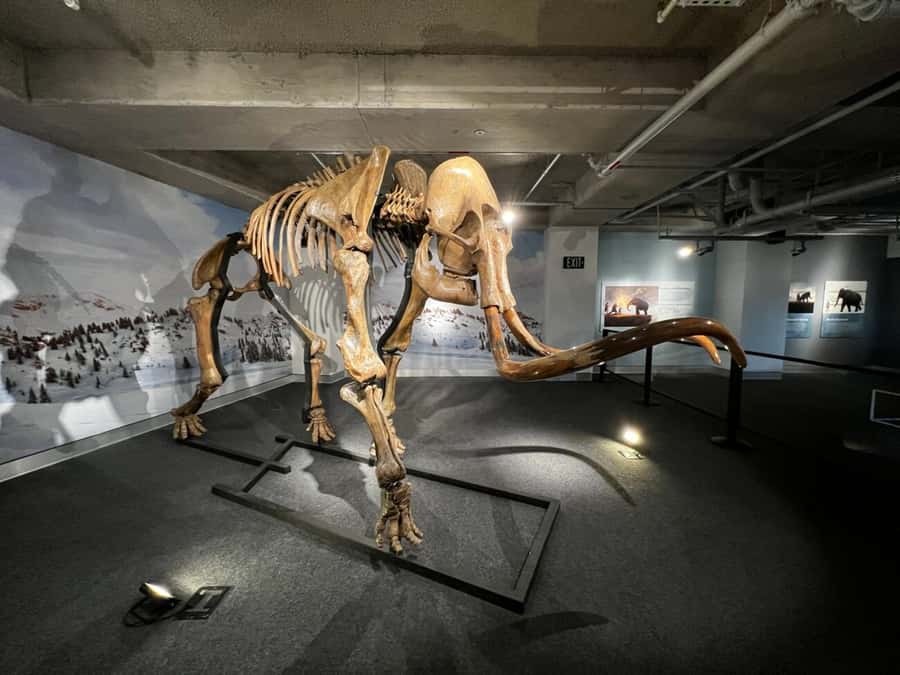
A few navigation details may require patience. Exhibit signage can be confusing in places. One display may appear on a board without a clear indication of which floor contains it, and a mammoth display was mistaken for a current exhibit when it seemed to be connected to something coming soon. If you cannot find a particular display, ask museum staff rather than spending too long searching.
Is $30 good value?
At $30 per person, this is not a bargain if you only want a quick aquarium visit. The ticket becomes much better value when you use the aquarium, interactive galleries, dinosaur exhibit, and planetarium in the same day.
I would compare it with the cost of separate activities in Miami. Here, one ticket combines animals, science experiments, space imagery, and a live theater show. That variety is useful for a family group with different interests. One person can focus on marine life while another prefers Mars, bugs, or black holes.
The value is also tied to the weather. Frost Science gives you a substantial indoor activity, which can rescue a hot, wet, or tiring Miami day. The facility is clean and suitable for different ages, so you are not forced to choose between a children’s attraction and an adult museum.
The main value warning is time. If you have only an hour or two, you will need to choose carefully, and the price may feel high. If you can stay three to four hours and attend a planetarium show, the ticket makes more sense.
The ticket cannot be applied toward the purchase of an annual membership. If you are considering membership, treat this admission as a separate one-day purchase rather than expecting the cost to transfer.
Who will enjoy Frost Science most?
I think this is a strong choice for families with children who like animals, machines, dinosaurs, or space. The museum gives you several ways to hold their attention, and you can switch subjects before boredom sets in.
It also suits adults who enjoy science presented through images and simple experiments rather than long blocks of text. The aquarium and planetarium provide plenty to look at, while the hands-on stations keep the visit active.
Very young children may not use every interactive exhibit, but they can still enjoy the colors, fish, sharks, stingrays, jellyfish, and planetarium imagery. If your child is too young for the hands-on displays, the aquarium may carry the visit on its own.
The experience is wheelchair accessible, and the skip-the-ticket-line feature can save time at entry. Food and drinks are not included, and hotel pickup and drop-off are not provided, so plan those parts separately.
My practical verdict
Book Frost Science if you want a flexible indoor attraction with enough variety for a mixed-age group. The strongest parts are the three-level aquarium, the stingray touch area, the striking dinosaur, and the planetarium’s wraparound screen.
I would not book it for a rushed stop or if your only goal is a short aquarium visit. Give yourself three to four hours, check the planetarium schedule at the start, and arrive early enough to claim a seat for the show you want. Used that way, the $30 ticket offers a full half day of activity rather than a quick look around.
FAQ
How long should I plan to spend at Frost Science?
Plan on three to four hours if you want to see the exhibitions, aquarium, and planetarium show without rushing.
Does the ticket include the aquarium?
Yes. Aquarium access is included with the Frost Science Museum entry ticket.
Is a planetarium show included?
Yes. The ticket includes one planetarium show. Available choices include Dynamic Earth and Black Holes, depending on the schedule.
Can I choose any planetarium show when I arrive?
Planetarium shows are available on a first-come, first-served basis. Check the show schedule and plan to arrive early enough to get a seat.
Can I touch a stingray?
Yes. The aquarium includes an opportunity to touch a stingray. You can also see hammerhead sharks and jellyfish.
Is the museum wheelchair accessible?
Yes. The activity is wheelchair accessible. Food and drinks, hotel pickup and drop-off, and annual membership upgrades are not included.
Recently reviewed around Miami
- Skip the Line: Wynwood Walls Admission Ticket★ 4.5 · 368 reviews
- Zoo Miami Ticket with Optional Upgrade★ 4.0 · 346 reviews
- Miami All-In-One: City Sightseeing & water taxi experience★ 4.5 · 456 reviews
- Wynwood Graffiti Golf Cart Small-Group Tour★ 5.0 · 1,646 reviews
- Miami: Superblue Miami Immersive Art Experience Ticket★ 4.0 · 367 reviews
- Miami Private Boat Cruise & Tour with a Captain★ 5.0 · 335 reviews
- A Taste of South Beach Food Tour★ 5.0 · 1,120 reviews
- Sail Biscayne Bay: An Intimate Eco-Adventure with Snorkeling★ 5.0 · 441 reviews
Museums, compared.


Empire State Building Tickets – Observatory & Museum
Read our review →


9/11 Memorial, Ground Zero Tour with Optional 9/11 Museum Ticket
Read our review →

All-Access 9/11: Ground Zero Tour, Memorial and Museum, One World Observatory
Read our review →
Browse the lists this tour appears in