
Reviewed · WALKING TOURS
Chicago’s Secret Interiors Architectural Walking Tour
Chicago saves some of its best architecture for indoors. This $35 walking tour leads you from Union Station through the Loop to grand lobbies, mosaic floors, domed ceilings, and old hotel interiors that are easy to miss from the sidewalk. You get the city’s famous skyline, but also the craftsmanship behind the doors.
I especially like the Rookery’s Frank Lloyd Wright lobby and the Marquette Building’s story-filled mosaics. I also like the way the tour connects architecture with Gilded Age money, railway power, retail ambition, and the people who made Chicago a center of modern building.
The main caution is that the route depends on building access and the day. The Rookery is closed Sundays, and the final cultural stop may be either the Chicago Cultural Center or the Monadnock Building. A few reports also describe groups larger than the advertised maximum of 15, so ask ahead if a small group matters to you.
In This Review
- Key points to know before you book
- Why Chicago’s interiors tell the bigger story
- Starting at Union Station on Canal Street
- Walking through the Financial Canyon on La Salle Street
- The Rookery’s light court and Wright-designed lobby
- The Field Building and Chicago’s Art Deco confidence
- The Marquette Building’s mosaics and Chicago windows
- The Palmer House and Chicago’s hotel age
- The Cultural Center or the Monadnock Building
- Marshall Field’s Tiffany dome and the finish on State Street
- What the $35 price really buys you
- Who will enjoy this walking tour most
- Should you book Chicago’s Secret Interiors tour?
- FAQ
- How much does the tour cost?
- How long does the experience last?
- Where does the tour begin?
- Where does the tour end?
- Is the Rookery included every day?
- What might replace the Chicago Cultural Center?
- What buildings are included on the route?
- Is the tour suitable for most people?
- Does the tour use a mobile ticket?
- Can I cancel for a full refund?
Key points to know before you book
- The Rookery is the star interior: Burnham and Root created the 1888 building, and Frank Lloyd Wright later reshaped its lobby.
- You walk through Chicago’s financial core: The route covers the Loop, La Salle Street, Union Station, and the blocks around State Street.
- Several interiors are the real prize: Expect mosaics, a Tiffany glass dome, a frescoed hotel ceiling, Art Deco details, and Beaux-Arts grandeur.
- The guides make or break the experience: Ethan, Grant, Ty, Avery, and Matthew are praised for clear stories, humor, group control, and strong knowledge of Chicago.
- The tour works in poor weather better than you might expect: Much of the time is spent indoors, though you still walk between buildings.
- Sunday has one important change: The Rookery is closed, so it will not be included on that day’s route.
Why Chicago’s interiors tell the bigger story
Chicago’s skyline is easy to admire from a boat or a riverwalk. This tour changes your angle. Instead of looking only up at towers, you step inside the commercial city that built them.
The Loop’s architecture records a fast shift in American life. Railways brought people and goods into the city. Banks and trading houses needed grand offices. Department stores turned shopping into a public event. Hotels competed to impress wealthy visitors. The buildings here are not just pretty shells. They show how Chicago’s business culture took shape.
I like that the guide’s stories are tied to the places around you. You hear about architects and engineers, but also magnates, celebrities, retailers, financiers, and the practical problems of putting tall buildings on Chicago’s soil.
The route is listed at about two hours, with each stop receiving roughly ten minutes. In practice, some tours have lasted closer to an hour and a half, including a break of about 15 minutes. That shorter length can be useful if you are fitting the tour between museums, shopping, or an architecture cruise.
You will need to walk outdoors from building to building, but a large part of the experience happens inside. That made the tour manageable even on a very cold or rainy day for some groups. Wear shoes suited to city sidewalks, and bring a coat in winter. Chicago’s weather can change quickly, even when the buildings are warm and calm.
More Walking Tours in Chicago
- Chicago: Gangsters and Ghosts Walking Tour
★ 5.0 · 7,155 reviews - Chicago Favorites Ultimate Food and Walking Tour
★ 5.0 · 1,962 reviews - Chicago: Gangsters and Ghosts Guided Walking Tour
★ 4.7 · 1,697 reviews
Starting at Union Station on Canal Street
The meeting point is outside Chicago Union Station at 225 South Canal Street. This is a practical starting place because the station itself is one of the route’s major architectural subjects.
Union Station was designed by Daniel Burnham and completed in 1925. Its Beaux-Arts exterior gives you the formal opening, but the Great Hall is what rewards you once inside. Look for the immense scale, the skylight, and the careful decorative work that made railway travel feel like a grand civic occasion.
I find this a smart first stop because it frames Chicago as a city built around movement. The station brought people into the commercial center, while the surrounding buildings gave those people places to work, trade, shop, and stay.
The stop is listed as free admission, since the tour price covers the guide rather than separate entry tickets. The guide will likely keep the group moving, so do not expect a long architectural lecture in each building. The value comes from the sequence: one important interior leads to another, and the walk between them lets you see how the Loop fits together.
Walking through the Financial Canyon on La Salle Street
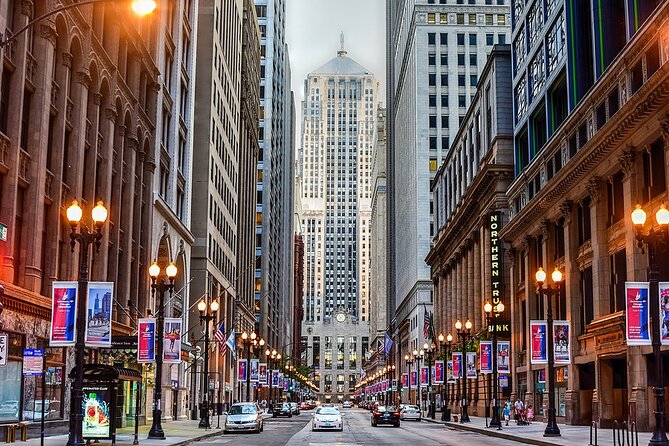
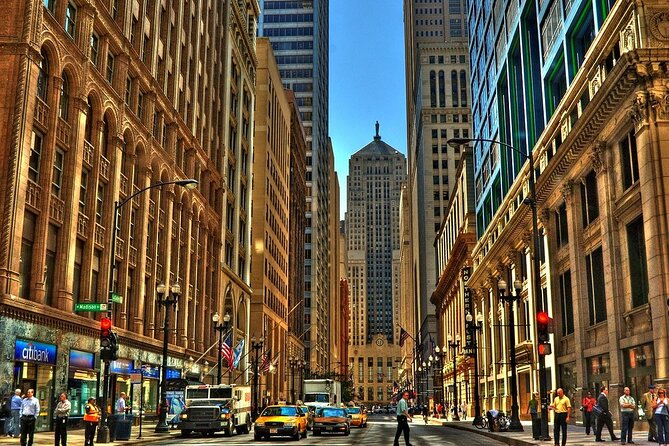
La Salle Street is often called Chicago’s Financial Canyon because tall buildings press in on the street and create a dramatic vertical corridor. This is one of the best places to understand the Loop from street level.
The route brings in major landmarks such as the Chicago Board of Trade and Willis Tower. They represent different periods and different ideas of commercial power. The Board of Trade’s Art Deco design has a bold, ceremonial quality. Willis Tower, with its soaring height, reflects Chicago’s later push toward bigger and taller office buildings.
This part of the tour is less about entering one spectacular room and more about learning to read the streets. Your guide points out how architects handled height, light, structure, and crowded urban blocks. You get a clearer sense of why Chicago became such an important laboratory for modern architecture.
The short ten-minute stop may feel rushed if you want detailed photographs of every facade. Still, it gives you useful context before the interior visits. I would keep your phone ready, but listen first. The guide’s explanation of the buildings and the industries inside them is more useful than trying to photograph every angle.
The Rookery’s light court and Wright-designed lobby
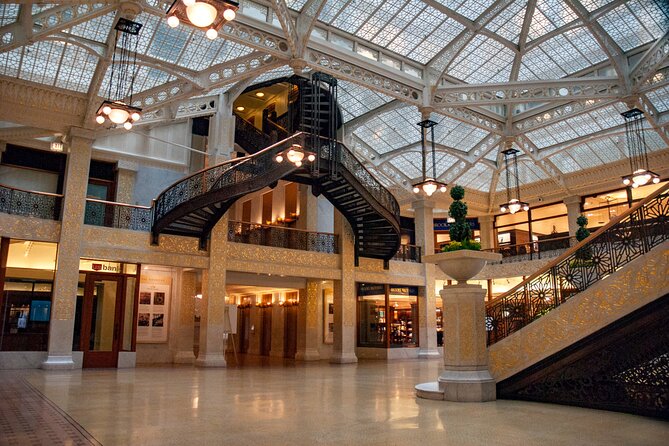
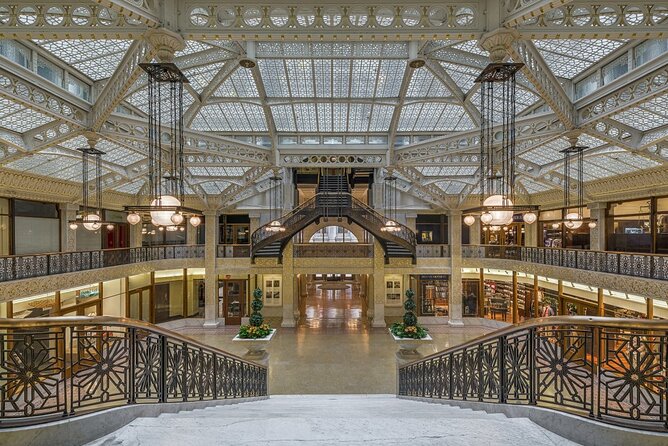
The Rookery is the most compelling reason to choose this tour, especially if you have already seen Chicago’s exterior landmarks. Burnham and Root designed the building in 1888, combining Romanesque and Moorish influences in a structure that helped define Chicago’s architectural identity.
Inside, the famous light court shows how architects brought daylight into a deep urban building. Ironwork, glass, stone, and the sweeping oriel staircase give the space a level of detail that is easy to overlook in photographs.
Frank Lloyd Wright later redesigned the lobby, adding a cleaner, brighter character while respecting the building’s original structure. That meeting of two design eras gives the Rookery unusual appeal. You are not looking at one architect’s fixed idea. You are seeing a building adapted over time.
I would allow yourself a few quiet moments here. Look up, then look at the railings and floor details. The guide’s short explanation helps you notice the relationship between decoration and engineering.
The Rookery is closed on Sundays, and the tour does not include it on that day. If this is your main reason for booking, choose another day. This is one of the few schedule details that can materially change the experience.
More Chicago walks with a guide:
- Chicago in a Day: Food, History & Architecture Walking Tour
★ 5.0 · 1,153 reviews - Chicago’s Chinatown Food and Walking Tour
★ 5.0 · 600 reviews - Chicago: Secret Interiors Architecture Walking Tour
★ 4.9 · 498 reviews - Chicago Gangster and Food Walking Tour
★ 5.0 · 471 reviews
The Field Building and Chicago’s Art Deco confidence
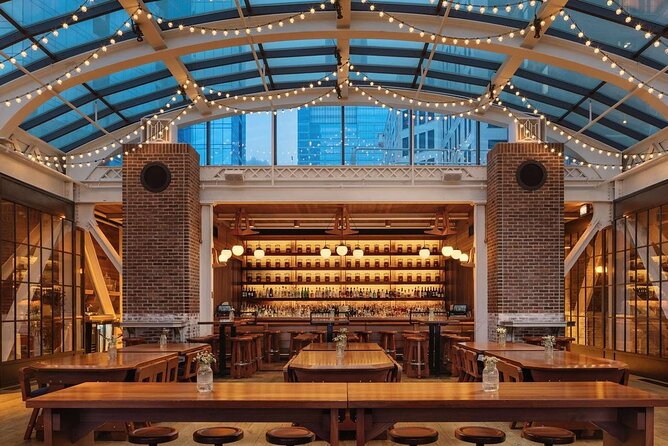
The historic Field Building adds an Art Deco chapter to the walk. Its design reflects a later Chicago, one that favored strong geometry, polished surfaces, and a sense of controlled luxury.
The building is useful in the tour’s overall rhythm. Union Station gives you Beaux-Arts grandeur. The Rookery shows early commercial experimentation. The Field Building brings you into the decorative confidence of the twentieth century.
The visit is brief, listed at about ten minutes, so you should not expect every design feature to receive equal attention. Instead, use the stop to compare periods. Notice how the mood changes from the ornate nineteenth century to the sharper lines of Art Deco.
This is also where a good guide adds real value. Ethan is praised for animated delivery and strong command of architecture and art. Grant is described as warm, organized, and careful about keeping people together. Those qualities matter when a short stop contains more detail than you can absorb at once.
The Marquette Building’s mosaics and Chicago windows
The Marquette Building is one of the most satisfying interior stops because it combines architectural technique with a clear historical theme.
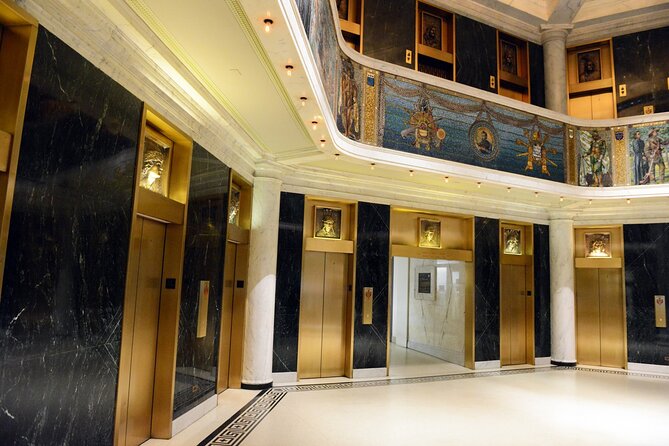
Its terra cotta facade and pioneering use of the Chicago window reflect the Chicago School of Architecture. The window design helped bring more light into office interiors while allowing broad views outward. That sounds practical, but it changed the appearance of commercial buildings and helped shape the modern office block.
Inside, the lobby mosaics tell the story of Jacques Marquette’s exploration of Illinois. The decoration is not random ornament. It connects the building to a larger version of Illinois history, presented in glass and tile.
This is a good place to slow your eyes down. Look at the mosaic panels, then step back to see how they work with the lobby as a whole. You may walk past this building on your own without realizing what is inside. That is the central strength of the tour: it turns ordinary-looking entrances into places worth entering.
The Palmer House and Chicago’s hotel age
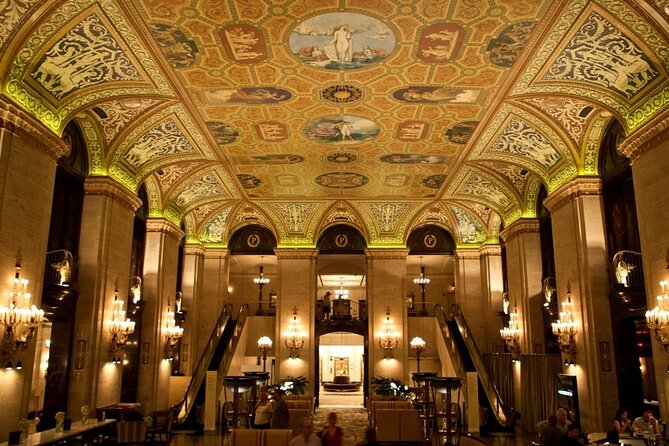
The Palmer House, now a Hilton hotel, brings the Gilded Age into the route. It was rebuilt after the Great Chicago Fire of 1871 and became one of the city’s grandest hotels.
Inside, the lobby is known for its frescoed ceiling, mosaic floors, and bronze peacock doors. These details were meant to impress from the instant a person entered. The hotel’s past also includes a long list of celebrities and dignitaries, giving the guide room to connect decoration with social life.
I like this stop because hotels reveal a different side of architecture. Banks and office buildings focus on work and money. A grand hotel also sells fantasy, comfort, and status. Its interior tells you what wealthy society wanted to see around itself.
The Palmer House can be active, so your group may need to keep moving and stay aware of hotel operations. That is not a flaw, but it means this is a guided glimpse rather than a private museum visit. Pay attention to the ceiling and door details before the group moves on.
The Cultural Center or the Monadnock Building
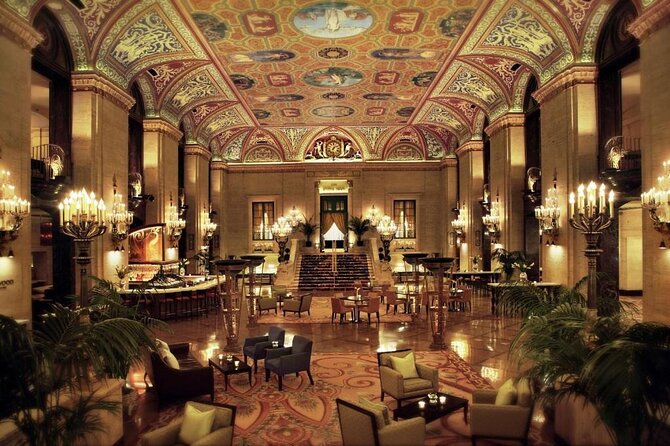
The eighth stop varies. You will either visit the Chicago Cultural Center or the Monadnock Building.
The Chicago Cultural Center offers another strong interior experience, with architectural beauty linked to Chicago’s cultural life. Its inclusion gives the tour a civic note after the commercial buildings and hotels.
The Monadnock Building provides a different lesson. It represents the commercial style of the late nineteenth century and helps show how Chicago architects worked with the weight and structure of tall masonry buildings.
Because the choice can vary, you should not book on the assumption that both places are included. If one matters greatly to you, confirm the route before setting out. The uncertainty is a small drawback, but it is worth knowing in advance.
Marshall Field’s Tiffany dome and the finish on State Street
The tour ends at the Marshall Field and Company Building, 111 North State Street, now home to Macy’s. This was one of Chicago’s great department stores, and its interior was designed to make shopping feel grand.
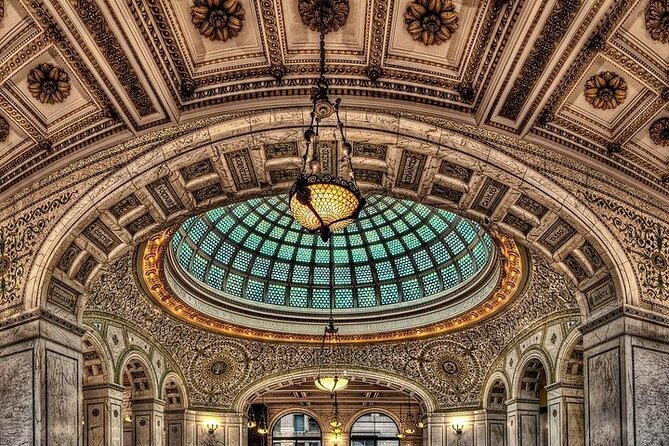
The famous Tiffany glass mosaic dome is the main attraction. The walnut-paneled Tea Room adds another layer of early twentieth-century luxury. Together, they show how department stores used architecture to create trust, comfort, and spectacle.
This is a fitting endpoint because retail helped shape the Loop just as much as finance did. The route begins with railway power and passes through offices, banks, hotels, and civic spaces before ending in a store built around public commerce.
The building remains an active shopping site, so conditions inside can vary. You may not have unlimited time to study every detail. Still, the dome alone gives the final stop a strong finish, and the location is convenient for continuing along State Street afterward.
What the $35 price really buys you
At $35, this is a good-value tour if you care about architecture but do not want to plan a building-by-building route yourself. Admission is listed as free at the stops, so you are paying mainly for the guide’s access, timing, and interpretation.
You could walk past many of these buildings on your own. The problem is knowing which doors to open and what to look for once inside. The guide adds the connection between a mosaic, a structural problem, a business empire, and the wider growth of Chicago.
The strongest guides appear to be the experience’s greatest asset. Ethan is described as energetic, clear, and passionate. Grant combines organization with a friendly manner. Ty is praised for being accommodating, entertaining, and full of useful detail. Avery and Matthew are also singled out for keeping groups moving and making the information easy to follow.
The rating is 4.9 from 635 ratings, with 98 percent recommending the experience. One serious service failure is recorded: a guide did not arrive, calls went unanswered, and a refund was offered the next day. That appears to be unusual beside the large number of positive accounts, but it is still a reason to keep your booking details and contact information handy on the day.
The listed group limit is 15 people. Some accounts describe groups of 15 to 20, and one describes a group of 40. If you want an intimate format, confirm the expected group size before booking rather than relying only on the published figure.
Who will enjoy this walking tour most
I would recommend it to first-time Chicago visitors who want more than exterior photo stops, and to residents who have passed these buildings without entering. It also pairs well with a Chicago architecture boat tour because the focus is different. The boat gives you the river views and skyline; this tour gives you the doors, ceilings, mosaics, and lobbies.
It suits anyone interested in architecture, urban history, engineering, hotels, department stores, or Chicago’s business past. You do not need specialist knowledge. The guides are described as able to explain complex subjects in a clear and entertaining way.
It is less suited to anyone who dislikes walking between stops or wants a long, quiet look at each interior. The schedule is brisk, and access can depend on the day. Most people can participate, and service animals are allowed. The start and end points are near public transportation, which helps with planning.
Confirmation arrives at booking, and a mobile ticket makes entry simple. Free cancellation is available up to 24 hours before the start time for a full refund. Inside 24 hours, changes and refunds are not accepted. If poor weather cancels the experience, you are offered another date or a full refund.
Should you book Chicago’s Secret Interiors tour?
Book it if you want to see the Chicago Loop from the inside and prefer a guide to connect the details. The Rookery, Marquette Building, Palmer House, and Marshall Field interiors give you plenty for the price, while Union Station and La Salle Street provide the larger city story.
Choose a non-Sunday date if the Rookery is important to you. Also confirm the group size if you want a quieter tour. For most people with two hours to spare, this is an efficient, reasonably priced way to discover a side of Chicago you might otherwise walk past.
FAQ
How much does the tour cost?
The tour costs $35.
How long does the experience last?
The listed duration is approximately two hours. Some accounts describe a tour closer to an hour and a half, including a break of about 15 minutes.
Where does the tour begin?
It begins at Chicago Union Station, 225 S Canal Street, Chicago, Illinois 60606.
Where does the tour end?
It ends at the Marshall Field and Company Building, 111 N State Street, Chicago, Illinois 60602.
Is the Rookery included every day?
No. The Rookery is closed on Sundays, so it is not included on the Sunday route.
What might replace the Chicago Cultural Center?
The route includes either the Chicago Cultural Center or the Monadnock Building for that stop.
What buildings are included on the route?
The route covers Union Station, the Rookery, the Field Building, the Marquette Building, Palmer House, either the Chicago Cultural Center or Monadnock Building, and the Marshall Field and Company Building. It also includes exterior and street-level discussion around Downtown Chicago and La Salle Street.
Is the tour suitable for most people?
Most people can participate. The tour is near public transportation, and service animals are allowed.
Does the tour use a mobile ticket?
Yes. A mobile ticket is provided.
Can I cancel for a full refund?
Yes, if you cancel at least 24 hours before the experience starts. Cancellations or changes within 24 hours are not refunded or accepted. If poor weather causes the tour to be canceled, you are offered another date or a full refund.
Recently reviewed around Chicago
- Delicious Donuts & City Sights: Chicago’s Original Donut Tour★ 5.0 · 1,389 reviews
- Field Museum of Natural History Admission Tickets★ 4.5 · 489 reviews
- City Cruises Chicago: Signature Lunch Cruise on Lake Michigan★ 4.0 · 348 reviews
- Bikes, Bites & Views: Chicago’s Signature Dishes Bike Tour-Adults★ 5.0 · 732 reviews
- Original Chicago Architecture Interiors Tour: Dazzling Interiors★ 5.0 · 1,489 reviews
- BYOB Spray Paint and Sip at Studio W.I.P.★ 5.0 · 401 reviews
- Skip-the-line: Art Institute of Chicago Guided Tour★ 5.0 · 417 reviews
- Chicago Architecture Tour: Underground Pedway and the Loop★ 5.0 · 388 reviews
Walking Tours, compared.
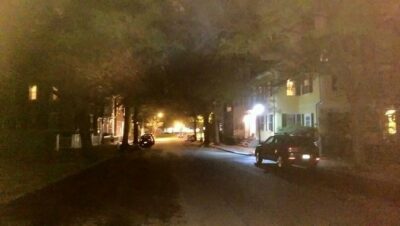
History and Hauntings of Salem Guided Walking Tour
Read our review →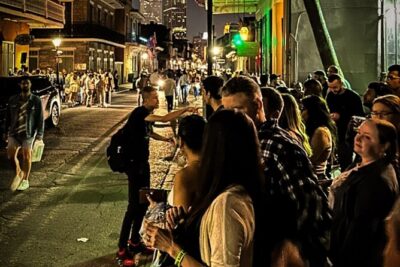
New Orleans Premier Ghost, Voodoo and Vampire Walking Tour
Read our review →
Freedom Trail History Small Group Walking Tour
Read our review →
Historic Charleston Guided Sightseeing Walking Tour
Read our review →
New Orleans Food Walking Tour of the French Quarter with Small-Group Option
Read our review →
St. Louis Cemetery No. 1 Official Walking Tour
Read our review →Browse the lists this tour appears in