
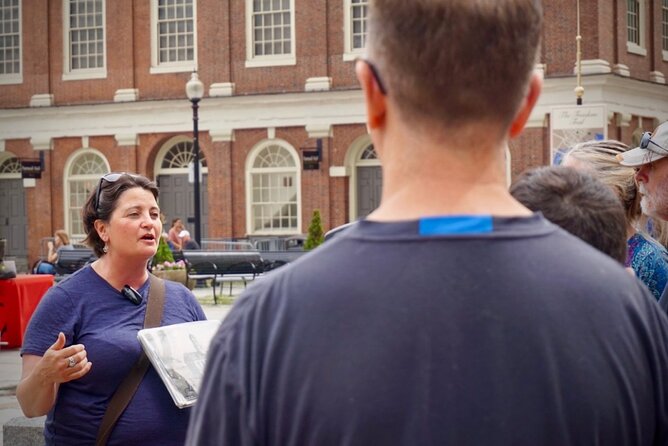
Reviewed · HISTORICAL TOURS
Boston: Freedom Trail History Small Group Walking Tour
Boston’s Freedom Trail is more than a red line through downtown. It is a compact route through the arguments, violence, politics, and personalities that pushed Boston toward revolution. This tour covers all 16 official historic landmarks, moving from Boston Common to the North End while your guide explains what happened between about 1760 and 1775.
I like the small maximum of 16 people, which gives you a better chance to hear the guide and ask questions. I also like the chronological approach used by guides such as Jon, Maura, Maz, and Alejandro. The drawback is simple: you walk and stand for most of 2.5 hours, and you do not go inside the museums or churches as part of the tour.
In This Review
- Key points at a glance
- Why this Freedom Trail walk works so well
- Starting in Boston Common at the Foundation Monument
- Boston’s oldest burial grounds and early churches
- Benjamin Franklin, Boston Latin School, and civic power
- The Boston Massacre site and Faneuil Hall
- North Square and Paul Revere’s neighborhood
- Finishing at Copp’s Hill Terrace
- The guide makes the difference
- Weather, walking, and access
- Who will get the most from this tour
- Booking, price, and cancellation details
- Should you book this Freedom Trail tour?
- FAQ
- How long is the Freedom Trail walking tour?
- How many people can join the tour?
- What language is the tour offered in?
- Where does the tour begin?
- Where does the tour end?
- Does the tour cover all of the official Freedom Trail landmarks?
- Are museum and church admission fees included?
- Is Charlestown included?
- Can I cancel for a full refund?
Key points at a glance
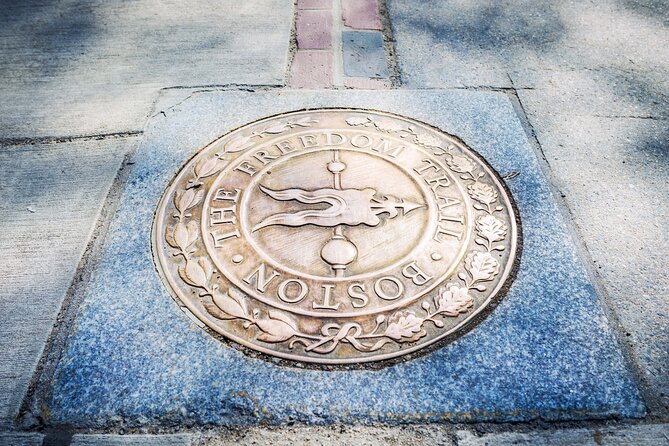
- All 16 Freedom Trail landmarks: You see the complete official route, from Boston Common to Copp’s Hill Terrace.
- A history-first walk: The focus is the tense period before the American Revolution, not just quick facts and photo stops.
- Small group size: The tour is capped at 16 people, allowing more room for questions and conversation.
- A useful first-day activity: The route gives you a strong sense of central Boston and the North End in one outing.
- Cold-weather planning matters: Winter guides may use indoor spaces for short warm-up breaks, but much of the tour remains outside.
- Good access, moderate effort: The route is wheelchair and stroller accessible, but long periods of standing may be difficult.
Why this Freedom Trail walk works so well
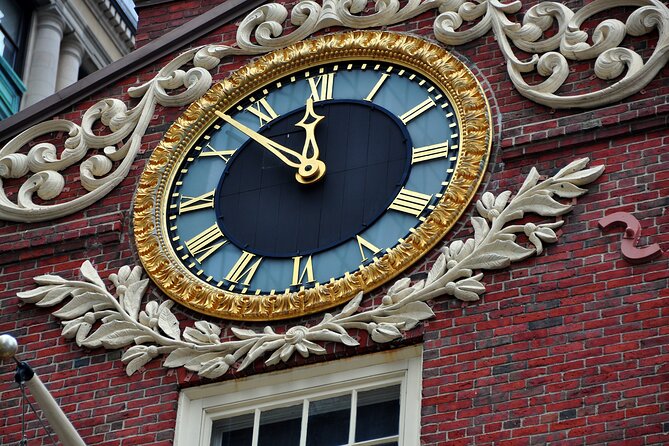
The best thing about this tour is its focus. You are not simply being led from one old building to another. The guide builds a story about Boston in the years when relations between colonists and Britain deteriorated.
That story has plenty of moving parts: taxes, trade, public meetings, military occupation, newspaper arguments, religious divisions, and the growing power of groups such as the Sons of Liberty. A good guide can connect these subjects while you move through the actual streets where they unfolded.
That human scale is the tour’s great strength. You see the place where five Bostonians were killed in the Boston Massacre, the meeting house linked to the Boston Tea Party, and the home of Paul Revere. The route helps you understand that the Revolution was not an abstract event. It grew out of disputes in crowded streets, meeting rooms, burial grounds, and marketplaces.
The tour costs $35.10 per person. For 2.5 hours with a historian guide and a group no larger than 16, that is a fair price, especially if this is your first visit to Boston. You are paying for interpretation, not admission tickets. Since the tour does not include museum entry, you may want to add the interiors later if a particular church or meeting house catches your attention.
More Historical Tours in Boston
- Tour of Historic Fenway Park, America’s Most Beloved Ballpark
★ 4.5 · 3,013 reviews - Boston Food & History: Pizza, North End & Freedom Trail
★ 5.0 · 1,772 reviews - Boston: City Cruises Historical Sightseeing Cruise
★ 4.6 · 1,771 reviews
Starting in Boston Common at the Foundation Monument
Meet inside Boston Common at the Boston Foundation Monument, near the park’s northern boundary and opposite 50 Beacon Street. The monument marks the arrival of the Puritans in 1630 and features a bronze relief of two men shaking hands.
This is a sensible starting point because Boston Common quickly gives you a feel for the city’s age and layout. The park began as communal grazing land in 1634 and is recognized as the oldest public land in the Americas. Your guide also points out the Massachusetts State Capitol, whose 1798 location helped inspire Boston’s nickname as the Hub of the Solar System.
You spend about 20 minutes in and around Boston Common. It is an easy place to meet, but arrive with enough time to find the monument inside the park. The exact meeting point matters because Boston Common has several entrances and the surrounding streets can be busy.
Boston’s oldest burial grounds and early churches
From the Common, the route turns toward several early religious and civic sites. The Granary Burying Ground is one of the tour’s strongest stops. Founded in 1660, it is Boston’s third-oldest burial ground and contains the graves of major figures from the Revolutionary period.
You will hear about the people connected to the city’s political struggle while standing among their actual burial places. The stop lasts about 20 minutes, giving your guide time to explain more than the names on the headstones.
The route also takes in the first Church of England in Puritan Boston, first established in 1686 and rebuilt in 1754, along with Boston’s oldest burying ground, dating to 1630. These places show that Boston’s religious life was never as simple as a single Puritan story.
Expect to view the churches from outside during the standard tour. This is one of the main limits of the experience. If you want to see the interiors of Old South Meeting House, Old North Church, or King’s Chapel, you need to pay for separate admission. A useful saving is available for Old South Meeting House and Old North Church with a Hub Town Tour ticket, and King’s Chapel is expected to receive the same discount soon.
Benjamin Franklin, Boston Latin School, and civic power
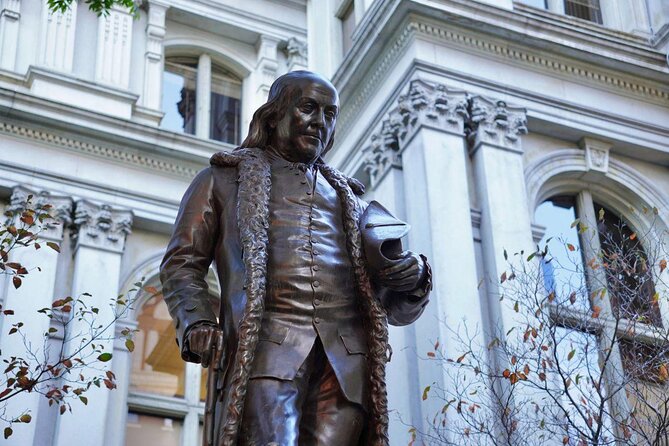
Near the statue of Benjamin Franklin, the guide discusses the site of Boston Latin School, founded in 1635 and regarded as the oldest public school in the Americas. Franklin attended the school, though he did not graduate.
This stop adds useful depth to the usual Revolution story. Boston was not only a place of protest. It was also a center of education, printing, commerce, and political debate. The statue and school site help you see how public life took shape around institutions that predated the Revolution by more than a century.
The route continues past places tied to Boston politics, publishing, and Congregational worship. You may hear about the former publishing house of Ticknor & Fields, a building with roots going back to 1718, and a Congregationalist meeting house established in 1729.
That meeting house is especially important because it is linked to the Boston Tea Party of 1773. The guide explains how public meetings could become engines of political action. This is where a good storyteller earns the tour price, since the location alone cannot explain why the event mattered.
More Walking Tours in Boston
- Cambridge: Harvard University Student-Guided Walking Tour
★ 4.6 · 3,931 reviews - Harvard University Campus Guided Walking Tour
★ 4.5 · 3,632 reviews - Boston Freedom Trail Walking Tour with Costumed Guide
★ 4.5 · 2,531 reviews - The Full Revolutionary Story Epic Small Group Boston Walking Tour
★ 5.0 · 2,356 reviews
The Boston Massacre site and Faneuil Hall
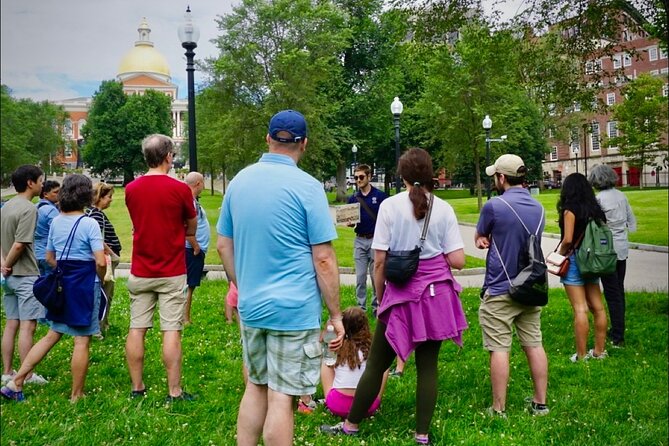
The Boston Massacre Site is another major pause, usually lasting about 20 minutes. In 1770, British soldiers killed five Bostonians here. The event became powerful political material, used by colonial leaders to strengthen opposition to British rule.
Your guide should help you separate the physical facts from the political language that followed. The site is now marked in the pavement, and it can be easy to walk past without realizing what happened there. A guide gives the spot its context and shows how propaganda, public fear, and military tension shaped the response.
You then reach the colonial capitol of Massachusetts Bay Colony, established in 1713 and described as Boston’s oldest public building. Nearby Faneuil Hall, built in 1742, hosted town meetings and earned the name Cradle of Liberty.
Faneuil Hall is still one of the most useful stops for understanding Boston’s political culture. It was a place where merchants, laborers, officials, and agitators could gather and argue. The tour spends about 10 minutes here, enough to explain its role without turning the walk into an indoor museum visit.
The route also passes the historic building associated with the city’s oldest restaurant, established in 1826. This is outside the main Revolutionary period, but it adds a later layer to the district. You are seeing a working part of Boston, not an isolated historic park.
North Square and Paul Revere’s neighborhood
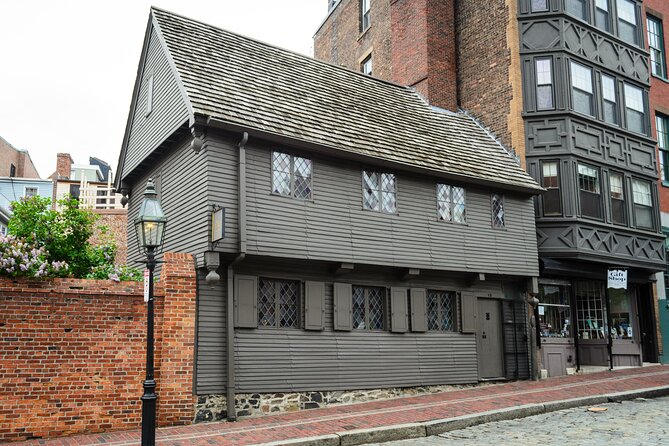
The walk into the North End changes the mood. Narrower streets and a stronger neighborhood feel replace the broad civic spaces around Boston Common and the State House.
North Square Park, established in 1634, sits at the heart of this part of Boston. You spend about 20 minutes in the area, learning how the North End developed and why it remains central to the Freedom Trail.
Paul Revere’s House is one of the route’s most familiar sites. Built in 1680, it is the oldest structure in Downtown Boston and was Revere’s home during the period surrounding his famous midnight ride. You see the house from the outside on this tour. Admission inside is not included.
That distinction is important. The tour explains why the house matters, but it does not replace a museum visit. If you have a strong interest in Paul Revere or colonial domestic life, plan to return with time for the interior.
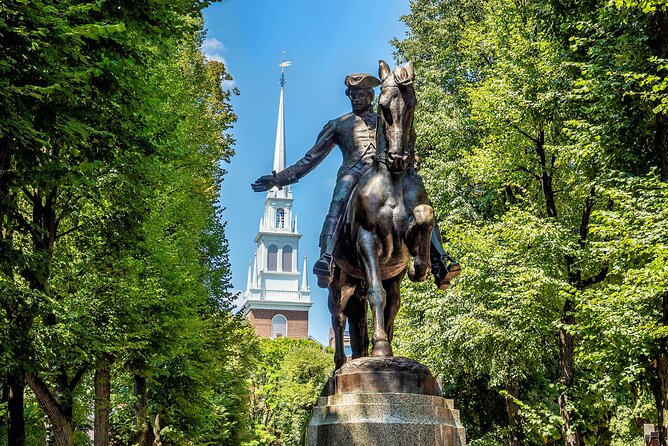
The Paul Revere Statue comes next, in a pedestrian area that honors the 1775 ride. The guide also points out Old North Church, Boston’s oldest church, where signal lanterns were displayed during the midnight ride. The story is often reduced to a single heroic image, but the guide’s broader account can help you understand the communication network and uncertainty behind the event.
The route includes the second-oldest burying ground in Boston before reaching the final stop. These burial grounds are not filler. They help you see how close daily life, death, worship, and politics were in colonial Boston.
Finishing at Copp’s Hill Terrace
The tour ends at Copp’s Hill Terrace on Commercial Street. This is a useful finish because it opens the view across the Charles River toward the USS Constitution and Bunker Hill Monument.
The terrace is also close to Hanover Street, where you can continue into the North End for Italian food, pastries, pizza, and other local specialties. Since the tour ends in a part of Boston that rewards lingering, I would avoid scheduling a rushed commitment immediately afterward.
Charlestown is not included. You can see major landmarks across the river, but reaching the USS Constitution and Bunker Hill Monument requires a separate visit. Keep that in mind if you want to cover the entire wider Freedom Trail area in one day.
The guide makes the difference
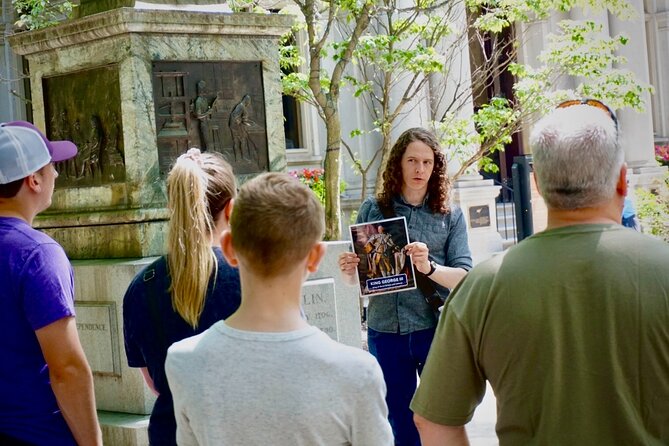
The subject is strong enough to carry a basic walk, but the guide determines how memorable it becomes. This experience uses historians and educators, and the guide names associated with recent departures include Jon, Maura, Maz, Mark, Nick, Alejandro, Kiera, Cal, Amelia, Miles, Meaghan, and Cyrus.
The most consistent strength is the way guides connect facts into a sequence. Jon has been praised for taking the group through events chronologically, while Maura and Maz are noted for vivid storytelling. Alejandro is especially attentive to cold conditions and looks for indoor places to tell parts of the story when possible.
The small group helps here. With a maximum of 16 people, you can ask about a person, building, or event without trying to interrupt a large crowd. The guide can also respond to the interests of the group. That is useful for families, since a child or teenager may need the story told in a more direct and lively way.
This is not a silent audio walk. You need to stay with the group, listen outdoors, and be ready to move when the guide signals. If you prefer exploring at your own pace, a self-guided walk may suit you better.
Weather, walking, and access
Boston weather can make a real difference. Several recent departures took place in freezing conditions, and guides used indoor breaks or covered spaces when possible. Still, you should dress for an outdoor walk, especially in winter. Wear warm layers and shoes that are comfortable on city sidewalks.
The tour lasts about 2 hours and 30 minutes. The route is described as wheelchair and stroller accessible, and service animals are allowed. At the same time, the activity requires a moderate level of physical fitness and is not recommended if you have difficulty standing for long periods.
That combination is worth taking seriously. Accessible does not mean effortless. You will spend much of the time on your feet, listening at outdoor stops, and walking between sites. If you need frequent seating or indoor shelter, ask before booking.
Who will get the most from this tour
I would choose this walk for a first visit to Boston, particularly if you want a clear introduction before exploring museums on your own. It is also a strong match for anyone who likes political history, biographies, old cemeteries, and stories tied to specific places.
Families can do well with it, especially with older children and teenagers who can handle the walking and sustained listening. One family completed the route with children aged 11 and 14, but the tour’s 2.5-hour history focus will not suit every young child.
It is also useful for solo visitors. You get an organized route through central Boston, a chance to ask questions, and a natural way to learn your bearings without spending the first day staring at a map.
I would hesitate if you mainly want interior access. The walk covers the outside of the churches, meeting houses, and Paul Revere’s House. You will need separate admission and extra time for that part.
Booking, price, and cancellation details
The $35.10 price is reasonable for a small-group walk covering the complete official Freedom Trail route. The value is strongest when you use it as an orientation activity, then return to the sites that interest you most.
It is commonly booked about 22 days ahead, so reserve earlier if your Boston dates are fixed. You receive confirmation at booking, and the ticket is mobile.
You can cancel for a full refund up to 24 hours before the start time. Cancellations or changes inside that window are not accepted for a refund. The tour also requires suitable weather and a minimum number of people. If the operator cancels for either reason, you are offered another date or experience, or a full refund.
Should you book this Freedom Trail tour?
Book it if you want the complete Freedom Trail in one well-paced walk, with a guide who explains the causes and personalities behind the Revolution. The combination of all 16 official sites, a 16-person limit, a central start, and a North End finish gives you a lot for $35.10.
Skip it if you dislike outdoor walking, need frequent seating, or want to tour the historic interiors during the same outing. For most first-time visitors, though, this is a smart way to begin Boston. Bring good shoes, prepare for the weather, and leave time afterward for the North End.
FAQ
How long is the Freedom Trail walking tour?
The tour lasts approximately 2 hours and 30 minutes.
How many people can join the tour?
The group has a maximum of 16 people.
What language is the tour offered in?
The tour is offered in English.
Where does the tour begin?
The meeting point is the Boston Foundation Monument inside Boston Common, near the northern boundary of the park and opposite 50 Beacon Street, Boston, MA 02108.
Where does the tour end?
The tour ends at Copp’s Hill Terrace, 520 Commercial Street, Boston, MA 02109.
Does the tour cover all of the official Freedom Trail landmarks?
Yes. The experience includes all 16 official historic landmarks on the Freedom Trail.
Are museum and church admission fees included?
No. Admission inside museums, churches, and other historic interiors is not included.
Is Charlestown included?
No. Charlestown is not included in this experience, although the final view from Copp’s Hill Terrace includes the USS Constitution and Bunker Hill Monument across the Charles River.
Can I cancel for a full refund?
Yes. You can cancel at least 24 hours before the experience start time for a full refund. Cancellations or changes made less than 24 hours before the start time are not accepted for a refund.
Recently reviewed around Boston
- Delicious Donuts of Boston: A Sweet History Walking Tour★ 5.0 · 1,038 reviews
- Boston’s Freedom Trail: A Revolutionary Walking Tour★ 5.0 · 1,343 reviews
- Freedom Trail Walking Tour 250★ 4.5 · 1,118 reviews
- Boston North End Food Tour of 6+ Tastings, Cannoli, Lobster Roll★ 5.0 · 1,404 reviews
- Narrated Sunset Cruise of Boston Harbor★ 4.0 · 532 reviews
- Sunset Sailing Cruise on a Tall Ship in Boston Harbor★ 4.5 · 414 reviews
- City Cruises Salem High Speed Ferry to/from Boston★ 4.5 · 727 reviews
- Boston Harbor Sunset Cruise★ 4.5 · 632 reviews
Historical Tours, compared.

History and Hauntings of Salem Guided Walking Tour
Read our review →
Charleston’s Old South Carriage Historic Horse & Carriage Tour
Read our review →

Big Island in a Day: Volcanoes Waterfalls Sightseeing and History
Read our review →
Historic Charleston Guided Sightseeing Walking Tour
Read our review →
Starship Landmark 90 Minute Sightseeing Cruise
Read our review →
Charleston Horse-Drawn Carriage Tour: Explore Historic Charleston
Read our review →Browse the lists this tour appears in