

Reviewed · MUSEUMS
USS Midway Museum Admission: Valid Any Date
The USS Midway is not a ship-shaped museum. It is a four-acre floating city where you can walk through sleeping quarters, engine spaces, galleys, the bridge, and a flight deck lined with aircraft. This was the largest ship in the world for about a decade, and its scale becomes clear with every stairway and narrow passage.
I like the freedom to arrive any time during the day, and I like that the audio tour is included rather than sold as an extra. The retired sailors and officers who volunteer around the ship add the human side. The main caution is simple: this is a big, physical visit, with many stairs and lots of ground to cover.
In This Review
- Key things to know before boarding
- What makes the USS Midway different from a normal museum
- Boarding at the Embarcadero
- Start high, then work your way through the ship
- The audio tour and 65 highlighted locations
- Yellow-shirt volunteers and the human side of the ship
- Living quarters, galleys, and officer’s country
- Engine room access and the working machinery
- Interactive exhibits and the flight simulator
- How long should you spend aboard?
- Price, parking, and practical value
- Who will enjoy the Midway most?
- When to book and how to plan the day
- Should you book the USS Midway Museum?
- FAQ
- What are the USS Midway Museum hours?
- How long does a visit to the USS Midway take?
- Is the audio tour included?
- Can I arrive at any time?
- Does the ticket let me skip all lines?
- Where is the USS Midway Museum located?
- Is parking available?
- Is the museum accessible?
- Can I cancel for a refund?
Key things to know before boarding
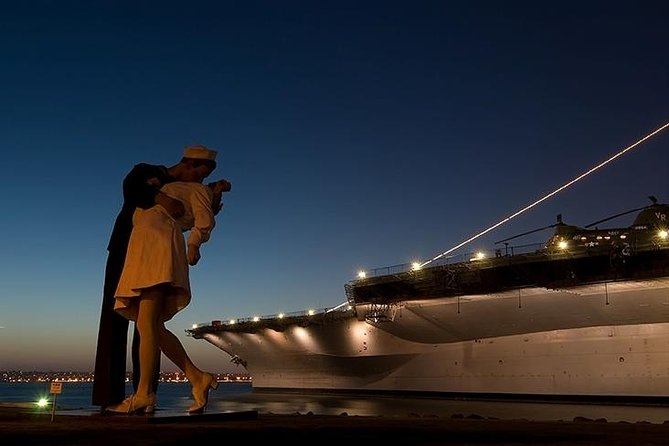
- A real aircraft carrier under your feet: The Midway served from 1945 to 1992 and carried more than 4,500 crew members at a time.
- Start on the flight deck: You get aircraft, harbor views, and a quick sense of the ship’s enormous size.
- The yellow-shirt volunteers matter: Former service members bring personal stories and practical details to selected areas.
- Plan at least three hours: Two hours gives you a useful visit, but four or five hours lets you explore without rushing.
- Admission is flexible: Your ticket is valid on any date, and you may arrive during museum hours without reserving a fixed tour time.
- Wear shoes for stairs: Comfortable walking shoes are essential, and early arrival helps when summer parking is limited.
What makes the USS Midway different from a normal museum

The USS Midway Museum gives you more than displays behind glass. You move through the actual working spaces of a carrier, sometimes in cramped corridors and sometimes across the open flight deck. The change in scale is part of the lesson. A sleeping area may feel tight, while the flight deck opens into a huge platform above San Diego Bay.
The carrier served in the US Navy from 1945 through 1992, making it the longest-serving aircraft carrier of the 20th century. More than 225,000 sailors served aboard during its working life. The museum turns those figures into something you can picture: rows of bunks, working kitchens, control rooms, machinery, and aircraft arranged where planes once operated.
I find the ship most interesting when it explains ordinary routines. Military history can become a list of dates and battles, but the Midway also shows how thousands of people ate, slept, worked, moved around, and maintained a functioning city at sea.
More San Diego museums and collections:
- San Diego: USS Midway Museum Entry Ticket
★ 4.9 · 3,896 reviews - NYC: 9/11 Memorial & Museum Timed-Entry Ticket
★ 4.8 · 31,428 reviews - NYC: Empire State Building Tickets – Observatory & Museum
★ 4.7 · 25,757 reviews
Boarding at the Embarcadero
The museum sits on San Diego’s downtown waterfront, at Navy Pier. You board directly from the Embarcadero, so the setting is part of the experience before you even enter the ship. The waterfront location also makes the Midway easy to combine with other downtown stops and public transportation.
Your mobile admission lets you proceed to the front gate instead of joining the ticket-purchase line. This does not remove lines inside the museum, and you still need to pass through the normal entry process. Keep your confirmation accessible on your phone. One booking problem reported by a visitor involved accessing tickets through a partner app, while the museum itself does not use an app, so saving the confirmation in advance is a sensible precaution.
Museum hours are 10 a.m. to 5 p.m., with last admission at 4 p.m. A 4 p.m. arrival may get you through the gate, but it is not a good plan for seeing much of the ship. I would arrive earlier, especially if you want to hear the volunteers, take the audio tour, eat at the café, or spend time with the aircraft.
Start high, then work your way through the ship
A useful approach is to begin near the flight deck and then work downward through the carrier. This gives you the grand view first and helps you understand how the interior spaces relate to the ship’s working purpose.
The flight deck covers about four acres and offers a 360-degree view of downtown San Diego. It is the best place to grasp the Midway’s size. From here, the carrier feels like a small neighborhood stretched over the water. The aircraft on deck add color and shape, while the open space gives you room to pause after the tighter areas below.
Several restored aircraft are arranged across the deck, and some exhibits allow you to climb aboard. The aircraft displays are a strong part of the visit for families, aviation fans, and anyone who wants a clear connection between the carrier and its purpose. You do not need a technical background to appreciate them. The planes make the flight deck easier to understand because you can see how much space was needed for aircraft operations.
The deck can also be a good reset point during a long visit. After a series of enclosed passageways, you can step outside, look across the harbor, and get your bearings before continuing.
The audio tour and 65 highlighted locations

The included audio tour uses stories from former Midway officers and sailors. That choice gives the narration a personal tone and helps explain spaces that might otherwise look like anonymous rooms full of equipment.
You can visit 65 highlighted locations across the vessel, from the bridge to the engine room. The audio tour is self-guided, so you choose your pace. If a section interests you, you can linger. If a technical display is not your thing, you can move along without waiting for a group.
The hangar deck also continuously shows a narrated video tour of the museum exhibits. This is useful if you want a broad introduction before heading through the ship, or if members of your group have different energy levels. You can stay in one area while others continue to explore.
I would not try to listen to every word while walking quickly. The Midway rewards patience. Stop at the sections that catch your attention, then speak with the volunteers when you see one in a yellow shirt. They often explain how a space worked in daily service and can add details that a recorded narration cannot.
A completely different way to spend a day nearby:
- San Diego Zoo 1-Day Pass: Any Day Ticket
★ 4.5 · 4,248 reviews - San Diego Harbor Cruise
★ 4.5 · 2,980 reviews - San Diego Hop On Hop Off Trolley Tour
★ 4.5 · 2,523 reviews - San Diego Whale Watching Cruise
★ 5.0 · 2,317 reviews
Yellow-shirt volunteers and the human side of the ship
The retired Midway volunteers are one of the strongest reasons to allow extra time. They are often positioned around the flight deck and other key areas, ready to explain aircraft operations, navigation, shipboard routines, and their own service experiences.
Their role is not just to point out machinery. They help connect the carrier’s physical spaces with the people who used them. A control area becomes easier to understand when someone explains the work done there. A sleeping space feels less like a display when you picture thousands of sailors living within the ship’s tight boundaries.
You should not plan your visit around one specific volunteer, since schedules and locations can vary. Instead, give yourself enough time to stop when a conversation starts. Several visitors have found that these exchanges were the most memorable part of the day.
For children and teenagers, the volunteers can make the ship more approachable. For adults with military, aviation, law enforcement, or family connections to service, the conversations may carry special weight. You do not need that background, though. The volunteers are also useful for basic questions and navigation.
Living quarters, galleys, and officer’s country

The restored living areas show what daily life was like inside a carrier. You can see sleeping quarters, galleys, and officer’s country, then compare the different spaces used by various ranks and departments.
The sleeping quarters are especially useful because they counter the idea that a massive ship must have spacious interiors. The Midway held more than 4,500 crew members, but the ship’s interior was organized for function, not comfort. Corridors and compartments can feel narrow, and you may need to share passageways with other people moving through the tour.
The galleys help you picture the practical work required to feed a city at sea. The ship could not simply pull into a harbor whenever supplies were needed, so food preparation and distribution were central parts of daily operations.
Officer’s country gives you another comparison point. Moving between different parts of the ship shows how work, rank, and living arrangements shaped life aboard. These rooms are not as visually dramatic as the aircraft, but they are among the best places to understand the human scale of the Midway.
Engine room access and the working machinery

The engine room is one of the highlighted areas available on the self-guided route. It helps explain how the carrier moved and how much support was required to keep the ship operating.
The Midway was too large to fit through the Panama Canal. That fact is more than a trivia point. It tells you something about the ship’s scale, design, and the limits created by its size. Walking through the machinery spaces gives that fact physical meaning.
The engine areas may appeal most to visitors who enjoy mechanical details, but they also help complete the story for everyone else. The aircraft and flight deck could not function without propulsion, power, maintenance, navigation, food service, and thousands of people working below deck.
The ship is not a smooth, single-level attraction. You move up and down between decks, and some routes require climbing stairs. Elevator access is available from Navy Pier onto the ship, from the hangar deck down to the second deck, and from the hangar deck up to the flight deck. Even with elevators, you should expect a moderate level of physical activity.
Interactive exhibits and the flight simulator
The interactive exhibits give younger visitors something to do beyond reading signs, but adults can enjoy them too. They help translate naval and aviation systems into hands-on experiences.
The flight simulator is an obvious stop for families and aviation fans. It adds a playful element after the more serious historical displays. Depending on how busy the museum is, you may need to wait for popular interactive features, so do not build your entire schedule around completing every activity.
The museum’s strength is the mix of experiences. You can listen to a former sailor’s account, inspect a restored aircraft, walk through a living space, study machinery, and then try a simulator. That variety helps keep a long visit from feeling like one extended corridor of static exhibits.
How long should you spend aboard?
The advertised visit can take roughly two to five hours. I would treat two hours as the shortest useful visit, not the ideal length.
With two hours, you can see the flight deck, several aircraft, major exhibits, and selected interior areas. This works if you have limited time in San Diego, but you will need to make choices.
Three to four hours is a better target for most people. It gives you time for the audio tour, the key living spaces, the flight deck, interactive exhibits, and a few conversations with volunteers. You can also stop for a snack or lunch without turning the day into a race.
Five hours makes sense if you like military history, aircraft, engineering, or firsthand stories. It also suits families who want to let children explore at their own speed. Bring water and consider a snack, although the ship has a café. Comfortable shoes are more important than a packed schedule.
Price, parking, and practical value
Admission costs $41 per person. That is not a minor museum ticket, but the price covers a large, self-guided attraction with an included audio tour, access to the ship’s public areas, aircraft displays, interactive exhibits, and volunteer interpretation.
I think the value depends on how long you stay. A rushed two-hour visit makes the ticket feel expensive. Four or five hours, especially with time for the audio tour and volunteers, makes the cost easier to justify. The Embarcadero Adventure offer, which includes discounts for other nearby attractions, may also improve the value if you plan to see more in the area.
Parking is adjacent to the Midway through Ace Parking for an additional fee. Summer parking can be limited, so early arrival is wise. You can also reach the museum near public transportation, which may be a better choice than driving into downtown.
Food and souvenirs are available aboard the ship. The café is convenient during a long visit, while the gift shop has the usual museum merchandise. Prices may feel high, so I would treat shopping as optional rather than part of the admission value.
Who will enjoy the Midway most?
The museum suits a wide range of interests, but it is especially strong for:
- Families looking for an educational attraction with hands-on elements
- Aviation fans who want restored aircraft and a working carrier setting
- Military history enthusiasts
- People interested in engineering, navigation, and ship operations
- Visitors with a personal connection to the armed forces
- Anyone wanting a major San Diego attraction that is more substantial than a quick photo stop
You do not need to be a military expert. The audio tour, signs, videos, and volunteers provide enough context to make the ship understandable.
It may be less suitable if you dislike stairs, enclosed spaces, extended walking, or attractions that require reading and listening at your own pace. The museum is wheelchair accessible in important areas, and elevator access is provided on stated routes, but the carrier’s layout still means you should expect some limits compared with a flat modern building. Service animals are allowed.
When to book and how to plan the day
The ticket is valid any date, and the museum operates daily from 10 a.m. to 5 p.m. That flexibility is useful if your San Diego schedule changes. Still, this attraction is commonly booked about a week ahead, so reserving early is sensible during busy periods.
I would choose a morning arrival. You have the best chance of finding nearby parking, and you can use the full day without worrying about the 4 p.m. last admission. If you arrive early, you can explore the flight deck first, have lunch at the café, and continue through the interior spaces afterward.
Do not schedule a tight appointment immediately after the museum. The ship’s size, stairs, volunteer conversations, and audio stops make the visit hard to predict precisely. If you have only two hours available, decide in advance whether aircraft, living spaces, or machinery matter most to you.
Should you book the USS Midway Museum?
Yes, if you want more than a quick downtown attraction. The Midway gives you a rare chance to walk through a full-size aircraft carrier and connect naval history with the daily lives of the people who served aboard it.
Book it if you can spare at least three hours, wear good walking shoes, and enjoy exploring without a fixed group route. The $41 price is fair when you use the audio tour, speak with the yellow-shirt volunteers, and take time with the ship’s many decks.
If you are short on time or have difficulty with stairs, plan carefully before buying. For most visitors to San Diego, though, the Midway earns its place on the schedule, especially when you approach it as a half-day museum rather than a quick photo opportunity.
FAQ
What are the USS Midway Museum hours?
The museum is open daily from 10 a.m. to 5 p.m. Last admission is at 4 p.m.
How long does a visit to the USS Midway take?
The visit generally takes about two to five hours. Plan on three to four hours for a comfortable visit, or around five hours if you want to explore slowly and speak with volunteers.
Is the audio tour included?
Yes. The admission includes a self-guided audio tour narrated through stories from former Midway sailors and officers.
Can I arrive at any time?
Yes. The ticket is valid any date, and you can arrive during regular museum hours. Last entry is at 4 p.m.
Does the ticket let me skip all lines?
The ticket lets you proceed to the front gate instead of waiting in the ticketing line. It does not remove lines for exhibits or activities inside the museum.
Where is the USS Midway Museum located?
The museum is on Navy Pier along San Diego’s downtown Embarcadero.
Is parking available?
Yes. Parking is available next to the Midway through Ace Parking for an additional fee. Parking can be limited during summer, so early arrival is encouraged.
Is the museum accessible?
Elevator access is available from Navy Pier onto the ship, from the hangar deck down to the second deck, and from the hangar deck up to the flight deck. The attraction states that visitors should have a moderate physical fitness level.
Can I cancel for a refund?
You can cancel at least 24 hours before the experience start time for a full refund. Cancellations or changes made within 24 hours are not accepted for a refund.
Recently reviewed around San Diego
- La Jolla Sea Caves Kayak Tour For Two (Tandem Kayak)★ 4.5 · 1,205 reviews
- Behind-the-Scenes at Petco Park Tour★ 4.5 · 339 reviews
- Kayak Tour of the 7 Caves★ 4.5 · 355 reviews
- Incredible Slot Canyons to the Pacific★ 5.0 · 373 reviews
- Original La Jolla Sea Cave Kayak Tour for Two★ 4.5 · 871 reviews
- SoCal Riviera Electric Bike Tour of La Jolla and Mount Soledad★ 5.0 · 438 reviews
- Cali Dreaming Electric Bike Tour of La Jolla and Pacific Beach★ 5.0 · 387 reviews
- Carlsbad Food Tour★ 5.0 · 516 reviews
Museums, compared.


Empire State Building Tickets – Observatory & Museum
Read our review →


9/11 Memorial, Ground Zero Tour with Optional 9/11 Museum Ticket
Read our review →

All-Access 9/11: Ground Zero Tour, Memorial and Museum, One World Observatory
Read our review →
Browse the lists this tour appears in