
Reviewed · HISTORICAL TOURS
Revolution and the Founders: History Tour of Philadelphia
Philadelphia’s revolutionary story comes alive block by block on this two-hour walk. You’ll see the Liberty Bell, Independence Hall, Franklin Court, Carpenters’ Hall, and the city’s early banks while a history-trained guide explains what happened here in 1776 and during Philadelphia’s years as the national capital.
I like the history-degree guides, especially when the storytelling is as lively as the best tours with Josh, Kyle, Joseph, Vince, and Ted. I also like the efficient route, which gives you a useful first look at Old City without taking your whole day. The main catch is that this is chiefly an outdoor orientation walk, not a ticketed tour of the major interiors.
In This Review
- Key points at a glance
- Why this Philadelphia history walk works
- Starting at Market Street
- The Liberty Bell and the meaning behind the crack
- Independence Hall and the work of founding a country
- The President House and Congress Hall
- Franklin Court and the world of Benjamin Franklin
- Carpenters’ Hall and the French connection
- Banks, political fights, and the early republic
- Scientific societies, libraries, and everyday Philadelphia
- Dolley Todd House and the human side of the founders
- How much walking and standing to expect
- Is $29 a good price?
- Which guide style will suit you?
- Who should book this tour?
- Should you book it?
- FAQ
- How long is the Revolution and the Founders tour?
- What sights are included?
- Does the tour enter the Liberty Bell Pavilion?
- Are Independence Hall tickets included?
- Where does the tour start and finish?
- Is the tour available in English?
- What happens if the weather is poor?
Key points at a glance
- A fast route through the founding era: Cover major Old City sights in about two hours, with morning and afternoon departures.
- History-trained guides: Guides have history degrees, and several also teach history or work as American history professors.
- The Liberty Bell from the outside: Learn how the bell became a national symbol, then decide if you want to wait separately for the pavilion interior.
- More than the usual two sights: The route includes Franklin Court, Carpenters’ Hall, Congress Hall, the First and Second Banks, and other early American landmarks.
- A small enough group to stay involved: The maximum group size is 24 people, with plenty of room for questions when the group is smaller.
- Good value at $29: You pay for interpretation and orientation, while Independence Hall and the Liberty Bell interior require separate free admission and extra time.
Why this Philadelphia history walk works
I see this tour as a strong first stop in Philadelphia, especially if you want the city to make sense before choosing which buildings and museums deserve a longer visit. The route connects places that can otherwise feel like separate photo stops.
The key is the guide. Each guide has a history degree, and the best ones turn dates and names into a sequence of human decisions. Josh is praised for funny, animated storytelling. Kyle has been known to act out scenes and even tailor the discussion to a couple’s interest in James and Dolley Madison. Joseph is described as a natural storyteller, while Vince is especially good at handling questions and adding detail without losing the group.
That style will not suit everyone. One low rating describes a guide whose acting became more important than the history. Most of the feedback is strongly positive, but you should know that the experience depends on the person leading your group. If you prefer a quiet, academic lecture, a highly theatrical guide may feel like too much.
More history-led days around the USA:
- New York City: American Museum of Natural History Ticket
★ 4.5 · 15,447 reviews - History and Hauntings of Salem Guided Walking Tour
★ 5.0 · 14,564 reviews - Charleston’s Old South Carriage Historic Horse & Carriage Tour
★ 5.0 · 10,023 reviews
Starting at Market Street
The meeting point is Grim Philly Twilight Tours at 523 Market Street. From there, the walk heads through the Old City section around Independence National Historical Park and finishes at the Merchant Exchange Building at 143 South Third Street.
This is a useful start and finish for sightseeing. The final stop is just behind City Tavern and the Merchant Exchange, near the area connected with the Continental Congress and Alexander Hamilton’s Philadelphia home. You are not dropped at a hotel, so plan to reach the start under your own power. The meeting point is near public transportation, and the tour is offered in English.
The group can include up to 24 people. That is not an intimate private walk, but it is still manageable for a city tour. The activity runs in rain or shine when conditions allow, so comfortable shoes and clothing suited to the forecast matter. In winter, take the weather warning seriously. Several tours took place in bitter cold, including one reported at 9 degrees, and even an enthusiastic guide cannot make standing outside comfortable for everyone.
The Liberty Bell and the meaning behind the crack
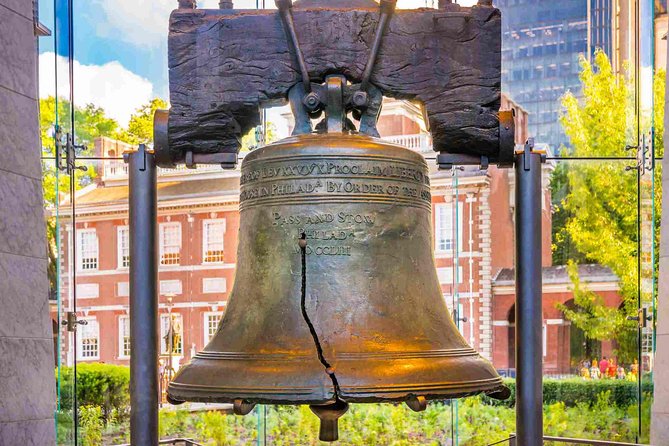
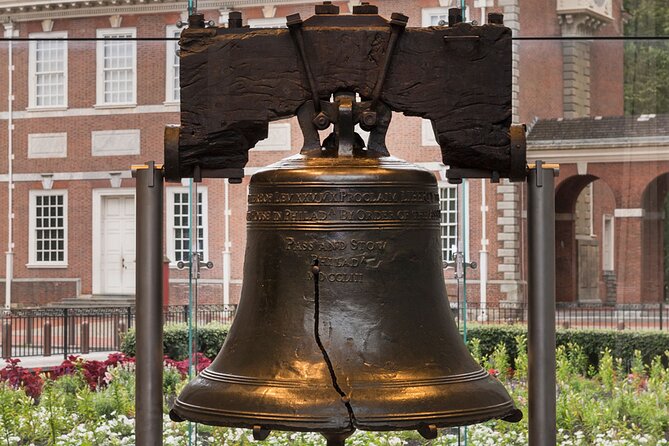
The Liberty Bell is often treated as a quick photograph, but the guide gives you the backstory from outside the pavilion. That approach saves time and helps you understand why the bell became a symbol rather than just an old object.
The bell was commissioned in 1752. It cracked during its first test ring and was cast again two years later by local workmen John Pass and John Stow. Its famous inscription comes from the King James Bible and refers to the jubilee, a time when enslaved people were freed and debts were forgiven every fifty years.
That context matters. The phrase became linked with American liberty, but its original meaning also points to freedom and debt relief in a broader social sense. A good guide can help you see the gap between the ideals expressed by the founders and the realities of colonial and early American life.
The walk does not include the inside of the Liberty Bell Pavilion. In busy periods, the line can take close to an hour. You receive directions for returning later if you want to enter, and admission is free. This is a sensible trade for a short tour, but budget another hour if seeing the bell up close is important to you.
Independence Hall and the work of founding a country

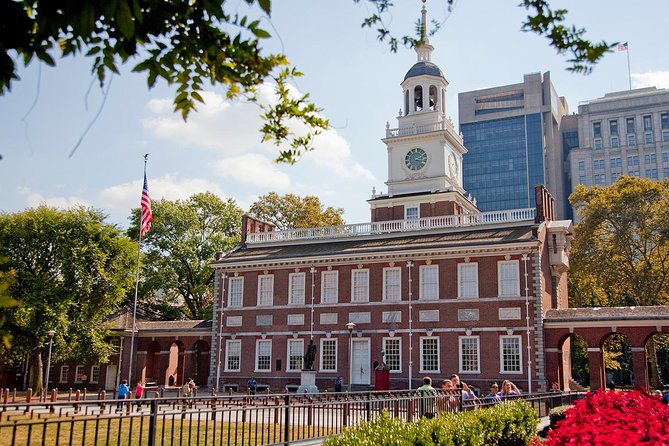
Independence Hall is the emotional center of the route. This is where the Declaration of Independence and the Constitution were debated and adopted, so the guide’s explanation can turn the red-brick building into a place of argument, compromise, and risk.
The tour keeps this stop moving. Depending on crowds and closures, the group may make a brief stop inside the East Wing of the complex, including the old Supreme Court Chambers, but you should not book this walk expecting a full interior visit.
Independence Hall requires free timed-entry tickets, and the tour price does not include them. You are advised to allow about two extra hours if you want to explore the complex properly. That makes the tour useful as an introduction: you learn what matters, then return with a better idea of what you are seeing.
I would treat this stop as orientation rather than replacement. If you have never visited Philadelphia, the guide can give you the basic story quickly. If Independence Hall is your top priority, arrange the timed ticket separately and leave enough space in your schedule.
A completely different way to spend a day nearby:
- NYC: SUMMIT One Vanderbilt Tickets
★ 4.7 · 51,195 reviews - NYC: 9/11 Memorial & Museum Timed-Entry Ticket
★ 4.8 · 31,428 reviews - NYC: Empire State Building Tickets – Observatory & Museum
★ 4.7 · 25,757 reviews - NYC: Empire State Building Observation Deck Tickets
★ 4.7 · 22,072 reviews
The President House and Congress Hall
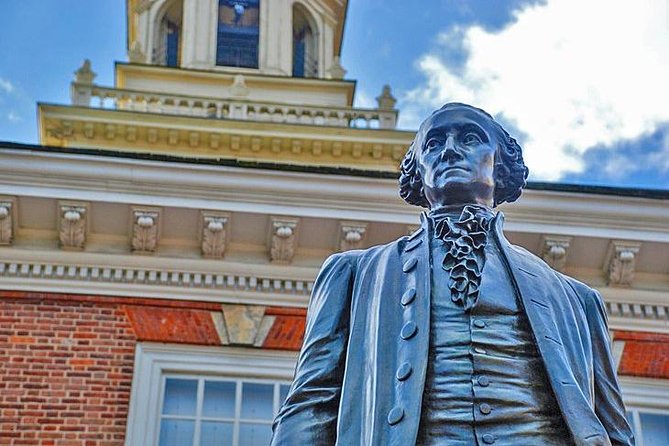
The route then moves through the years when Philadelphia served as the national capital, from 1790 to 1800. At the President House site, you learn about the building where George Washington and John Adams served as president.
The site also connects to foreign dignitaries, members of Congress, and Benedict Arnold, who lived there as military governor after the British left Philadelphia. It is a useful reminder that the new government was not always based in Washington, D.C. The young republic operated from a city that was already an active port, political center, and commercial hub.
Congress Hall adds another layer. The building hosted the U.S. Congress and two presidential inaugurations, Washington’s and Adams’s. I like this part of the route because it moves the story beyond the famous 1776 moment. You see how the new nation tried to function after independence, with presidents, legislators, diplomats, and political rivals sharing a compact urban center.
Franklin Court and the world of Benjamin Franklin
Franklin Court offers one of the tour’s best changes of pace. The complex includes museums, structures, and historic sites associated with Benjamin Franklin, who lived here during the period of the Constitutional Convention.
The guide discusses Franklin as a printer, publisher, inventor, electrical experimenter, diplomat, and statesman. That range is important. Franklin was not simply an old man with a kite and spectacles. His influence came from combining practical business, scientific curiosity, political judgment, and an ability to build institutions.
You also hear the famous idea that the founders had to cooperate or face defeat separately. The point is more than a good line. The American Revolution required alliances among colonies that had different economies, religions, and political interests. The later French alliance was also crucial, a subject that receives special attention at Carpenters’ Hall.
The route includes the Benjamin Franklin Post Office and Museum, the only Colonial-themed post office operated by the United States Postal Service. It still uses the B. Free Franklin postmark, and it does not fly the American flag because the flag did not yet exist in 1775, when Franklin was appointed postmaster general.
The museum is on the second floor and contains postal displays and memorabilia. The tour gives you the outside context and points out what you can see later. If you enjoy small, specific historical details, this is one of the stops worth revisiting.
Carpenters’ Hall and the French connection

Carpenters’ Hall hosted the First Continental Congress in 1774. It also became the setting for secret meetings in December 1775, when Franklin met with John Jay, Francis Daymon, and the French agent Julien Achard de Bonvouloir.
Those meetings helped open negotiations for French support of the colonists. That support later proved essential to the American cause. The building therefore tells two stories at once: colonial representatives trying to coordinate their response to Britain, and American leaders quietly seeking help from a European power.
The hall was also occupied by British forces during the winter of 1777, when the British controlled Philadelphia. That detail helps you picture the war as a struggle over real streets and buildings, not a distant sequence of battles.
Again, the value here comes from interpretation. A building can look modest from the sidewalk. With the right explanation, you understand why a meeting held inside could influence the outcome of a war.
Banks, political fights, and the early republic
The First Bank of the United States brings Alexander Hamilton into the walk. Hamilton, the first Secretary of the Treasury, championed the bank, which was founded in 1797. The building is also important for its design, giving you a chance to consider how architecture helped express the authority of the new federal government.
The Second Bank of the United States continues the argument. Chartered by President James Madison in 1816, it lost its charter during Andrew Jackson’s presidency in 1834. Here the guide compares Hamilton and Jackson, including the duels associated with both men.
This section is useful because it shows that the founders did not agree on everything. Early American politics included fierce disputes over federal power, finance, executive authority, and the shape of the republic. The tour does not stop with patriotic symbols. It gives you some of the friction that made the period so difficult and so interesting.
Scientific societies, libraries, and everyday Philadelphia
The American Philosophical Society was founded by Franklin in 1743, two years after the University of Pennsylvania. Early members included Washington, Adams, Jefferson, Hamilton, Thomas Paine, David Rittenhouse, James Madison, and other major figures.
The guide also connects this area with the University of Pennsylvania and America’s first surgical center. You may not spend long at the site, but the stop shows how the city’s founding story included science, education, medicine, and organized debate.
Nearby, the Library Company traces back to Franklin’s 1731 foundation. It is described as the first institution in the world to lend materials to members of the public. The stop helps explain how ideas circulated among early statesmen and citizens.
I appreciate these quieter locations because they broaden the definition of the American founding. Philadelphia was not only a place where politicians signed documents. It was also a city where people created libraries, scientific societies, banks, newspapers, schools, and medical institutions.
Dolley Todd House and the human side of the founders
The walk includes the site of the home where Dolley Madison, then Dolley Todd, lived with her first husband, John Todd, from 1791 to 1793. The house was built in 1775 and reflects middle-class life in eighteenth-century Philadelphia.
This stop gives the tour a domestic scale. After hearing about presidents, Congress, banks, and secret diplomacy, you get a glimpse of how an ordinary urban home fit into the same streets used by national leaders.
It also provides room for the personal story of James and Dolley Madison. One guide used that relationship to add a romantic thread to the larger political tale. That kind of human detail can help younger visitors and anyone who finds institutional history dry.
How much walking and standing to expect
The tour covers a lot of ground in two hours. It is not a bus ride or a hop-on, hop-off circuit, so you should expect continuous walking between sites and periods of standing while the guide explains a building or event.
Most participants can take part, children must be accompanied by an adult, and service animals are allowed. The activity is near public transportation, but hotel pickup and drop-off are not included unless you select an option that provides it.
The pace is one of the tour’s strengths. You see many important sites before lunch or before an afternoon of sightseeing. The drawback is that each stop receives only a short explanation. If you want to study one building in detail, you will need to return on your own.
Is $29 a good price?
At $29 per person, I consider this a fair price for a guided introduction to central Philadelphia. You are paying for a history-trained guide, a carefully arranged route, and interpretation at a long list of important sites.
The value is strongest for a first visit. You can use the walk to learn which places deserve more time, then spend the rest of your day at the museums or interiors that interest you most. The tour also saves you from wandering between landmarks without understanding how they connect.
The price does not include Independence Hall timed tickets or entry to the Liberty Bell Pavilion. Both are free, but they require separate time and planning. If you want a full interior program, the $29 tour is an add-on, not a substitute.
Which guide style will suit you?
The most praised guides are energetic storytellers. Josh is frequently singled out for humor, drama, and clear explanations. Kyle has been compared playfully to James Madison because of his emotional delivery and historical role-playing. Joseph is praised for passion and for arranging the story in a logical sequence. Vince is especially strong with questions and may keep the group engaged beyond the scheduled two hours. Ted has worked hard to keep groups moving and interested in very cold conditions.
That energy can make a large amount of information easier to remember. It can also feel theatrical if you prefer a restrained presentation. I would book this tour if you like anecdotes, acted-out scenes, questions, and a guide who treats history as a story with characters.
Who should book this tour?
I recommend it for first-time visitors, history buffs, families with school-age children, couples who want a strong introduction before exploring alone, and solo visitors who prefer a guided orientation. It is also a good fit if you have only a morning or afternoon available.
I would choose something else if you want extensive indoor access, a slow architectural study, or a private experience with a fixed guide. The tour is mainly outdoors, and the exact amount of time spent inside depends on crowds and closures.
Free cancellation is available until 24 hours before the start time. Cancellations or changes inside that window are not refunded, and poor weather or failure to meet the minimum group size can lead to a different date or a full refund.
Should you book it?
Book this walking tour if you want the founding story in one efficient route and enjoy a guide who can make political history personal. The best version gives you the Liberty Bell, Independence Hall, Franklin, Hamilton, Madison, French diplomacy, and early American institutions in a single connected story.
Just set your expectations correctly. You will see many sites, but you will not receive a full interior tour of the major buildings. Wear shoes for walking, prepare for the weather, and reserve extra time afterward for Independence Hall or the Liberty Bell if those interiors matter to you. At $29, it is a sensible way to get your bearings and decide where to spend the rest of your Philadelphia visit.
FAQ
How long is the Revolution and the Founders tour?
The walking tour lasts approximately two hours.
What sights are included?
The route includes the Liberty Bell, Independence Hall, the President House site, Congress Hall, Franklin Court, the Benjamin Franklin Post Office and Museum, Carpenters’ Hall, the First and Second Banks of the United States, the American Philosophical Society, the Library Company, and the Dolley Todd House site.
Does the tour enter the Liberty Bell Pavilion?
Interior entry to the Liberty Bell Pavilion is not included. The guide explains the bell from outside and provides directions if you want to return and wait for entry. The interior visit is free but may take about an hour during busy periods.
Are Independence Hall tickets included?
No. Independence Hall requires free timed-entry tickets, and those tickets are not included in the tour. You should allow about two additional hours if you want to explore the complex inside.
Where does the tour start and finish?
The tour starts at Grim Philly Twilight Tours, 523 Market Street, Philadelphia. It ends at the Merchant Exchange Building, 143 South Third Street, just behind City Tavern and the Merchants Exchange.
Is the tour available in English?
Yes. The tour is offered in English.
What happens if the weather is poor?
The tour requires suitable weather. If the operator cancels because of poor weather, you will be offered another date or a full refund. You can also cancel for a full refund if you do so at least 24 hours before the start time.
Recently reviewed around the USA
- Dyker Heights Christmas Lights Guided Tour★ 4.5 · 920 reviews
- New York City Dinner Cruise with Live Music★ 4.0 · 377 reviews
- New York City Holiday Lights Tour★ 4.5 · 664 reviews
- NYC in a Day Tour: Statue of Liberty, Times Square and More★ 5.0 · 366 reviews
- Broadway and Times Square Insider Tour with Theater Professional★ 5.0 · 651 reviews
- NYC Central Park Bicycle Rentals★ 4.5 · 368 reviews
- Central Park Bike Rental New York City★ 4.0 · 560 reviews
- Manhattan Sky Tour: New York Helicopter Flight★ 4.5 · 1,458 reviews
Historical Tours, compared.

History and Hauntings of Salem Guided Walking Tour
Read our review →
Charleston’s Old South Carriage Historic Horse & Carriage Tour
Read our review →

Big Island in a Day: Volcanoes Waterfalls Sightseeing and History
Read our review →
Freedom Trail History Small Group Walking Tour
Read our review →
Historic Charleston Guided Sightseeing Walking Tour
Read our review →
Starship Landmark 90 Minute Sightseeing Cruise
Read our review →Browse the lists this tour appears in