
Reviewed · HISTORICAL TOURS
Charleston History Tour /
Charleston’s past comes into focus on foot, one handsome block at a time. This roughly two-hour walk connects the city’s grand public buildings with its harder, more complicated stories, including the lives and culture of the Gullah people. You’ll also hear about a home built in 1771 that played a part in the ratification of the United States Constitution.
I like the small group limit of 10, which gives the guide room to answer questions and adjust the pace. I also like the range of stops: elegant architecture, a harbor promenade, churches, and Rainbow Row all fit into one compact outing. The main caution is that the tour requires moderate physical fitness, and one serious service failure has been reported when a guide had a medical emergency.
In This Review
- Key points to know
- What this Charleston walk gives you in two hours
- Dock Street Theater and Charleston’s taste for grand design
- St. Michael’s Church and the city’s early religious life
- Rainbow Row, nine connected buildings
- The Battery and White Point Gardens beside Charleston Harbor
- French Huguenot Church and a distinct Charleston tradition
- Gullah culture keeps the tour from becoming a pretty-streets walk
- A guide-led walk with a personal feel
- Timing, walking effort, and what to bring
- Who will get the most from this tour
- Should you book the Charleston History Tour?
- FAQ
- How long does the Charleston History Tour last?
- Where does the tour begin?
- Where does the tour end?
- What locations are included?
- Are admission fees included?
- What happens if the weather is poor?
Key points to know
- A compact tour of Charleston’s historic center: Five major stops fit into about two hours.
- Guide Joyce receives special praise: She connects architecture, military events, city growth, and culture in an easy, personal way.
- Gullah culture is part of the story: This is more than a parade of pretty buildings.
- No added admission payments for included sites: The listed attractions are covered in the experience.
- The group is capped at 10 people: That can make questions and conversation easier.
- Weather matters: Poor conditions can lead to a new date or a full refund.
What this Charleston walk gives you in two hours
Charleston can feel like a city best seen slowly. Its streets are filled with fine details, but a first-time visitor may not know which doorway, church, or seawall deserves attention. This tour gives you a clear route through the old center without asking you to spend a full day on your feet.
The focus is not only on architecture. You’ll hear about the city’s development, military connections, constitutional history, and Gullah culture. That mix matters. Charleston’s polished streets tell only part of the story, and the cultural section adds needed depth to the pretty facades.
The group limit of 10 is useful here. A small walking group usually means you can hear the guide more easily and ask a question without holding up a large crowd. It also leaves room for a more personal style of guiding. Joyce, one of the named guides, is especially praised for making the walk feel like time spent with a friend showing you around town.
The tour begins and ends at 80 Broad Street, making the plan simple. You do not need to arrange transport between stops. Since the activity lasts about two hours, it can fit neatly into a morning or afternoon, though you should leave room for the walk between sights and for the possibility that the pace varies.
More Historical Tours in Charleston
- Charleston’s Old South Carriage Historic Horse & Carriage Tour
★ 5.0 · 10,023 reviews - Historic Charleston Guided Sightseeing Walking Tour
★ 5.0 · 6,216 reviews - Charleston Horse-Drawn Carriage Tour: Explore Historic Charleston
★ 5.0 · 3,561 reviews
Dock Street Theater and Charleston’s taste for grand design
The Dock Street Theater is the first listed stop. Its ornate playhouse design, elegant woodwork, and courtyard introduce you to Charleston’s love of formal buildings and public entertainment.
The theater is associated with the early nineteenth century, around 1810 in the tour details. You’ll spend about five minutes here, with admission included. That is enough time for a focused explanation and a look at the exterior or accessible areas, but not enough for a full performance or extended interior visit.
The short stop works well as part of a walking route. You get the building’s place in the city without using a large part of your two-hour window. If theater interiors are your main interest, you may find this visit too brief. For a broad city tour, though, it gives you a strong architectural opening.
Pay attention to the woodwork and courtyard. These are the details that can disappear when you simply walk past. A guide can explain what you are seeing and connect the theater to the wider growth of Charleston.
St. Michael’s Church and the city’s early religious life
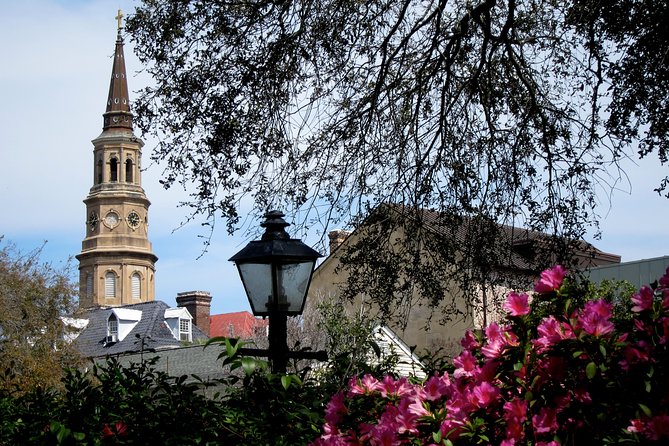
St. Michael’s Church dates to about 1764 and is described as the oldest religious building in Charleston. That makes it an important stop even for visitors who do not plan to visit every historic church in town.
The listed visit lasts about five minutes, with admission included. You should expect a concise introduction rather than a long service-style visit or an extended architectural study. The value comes from seeing the church in context, alongside the other buildings that shaped the city’s public life.
This is also where a guide’s wider knowledge helps. A good explanation can move beyond dates and point out how a major church fits into Charleston’s civic and social history. Joyce is praised for doing this kind of connecting work, bringing together architecture, military facts, city growth, and cultural topics instead of treating each stop as an isolated postcard.
The stop may feel quick if you want time for quiet reflection or detailed photography. Still, the short format keeps the tour moving and allows the route to cover several different sides of the city.
Rainbow Row, nine connected buildings
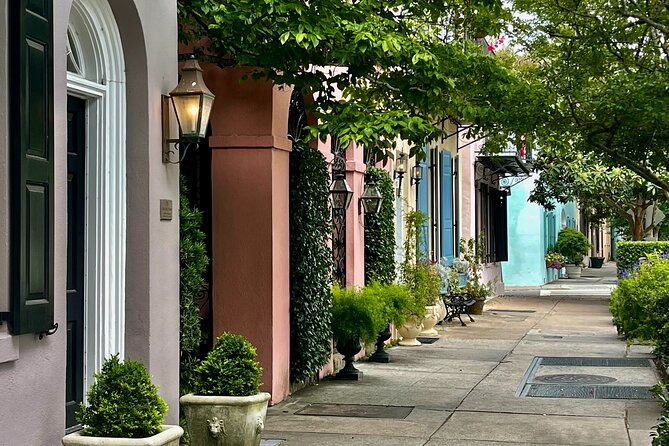
Rainbow Row gives you one of Charleston’s most recognizable views. The row consists of nine attached buildings, and all but one predate the American Revolution. That fact makes the scene more than a string of colorful facades. It shows how much of Charleston’s early street pattern and building stock has survived.
You’ll spend about five minutes here, with admission included. The stop is best for taking in the line of buildings, hearing why the row matters, and noticing how the connected structures differ from one another.
The tour format helps because a guide can give the place a time frame and explain what you are looking at. Without that context, Rainbow Row can become a quick photo stop. With it, the buildings become evidence of the city’s early commercial and residential life.
Do not expect a long pause for private exploration. Five minutes is a short window, especially if the group wants photographs. Keep your camera ready, listen for the key points, and save a return visit for later if this becomes one of your favorite views.
More history-led days around Charleston:
- Charleston Harbor History Day-Time or Sunset Boat Cruise
★ 4.5 · 2,788 reviews - Hidden Alleyways and Historic Sites Small-Group Walking Tour
★ 5.0 · 2,335 reviews - Charleston: Daytime or Sunset Historic Harbor Cruise
★ 4.5 · 1,352 reviews - Charleston historical walking tour with a Professor of History at The Citadel
★ 5.0 · 1,284 reviews
The Battery and White Point Gardens beside Charleston Harbor
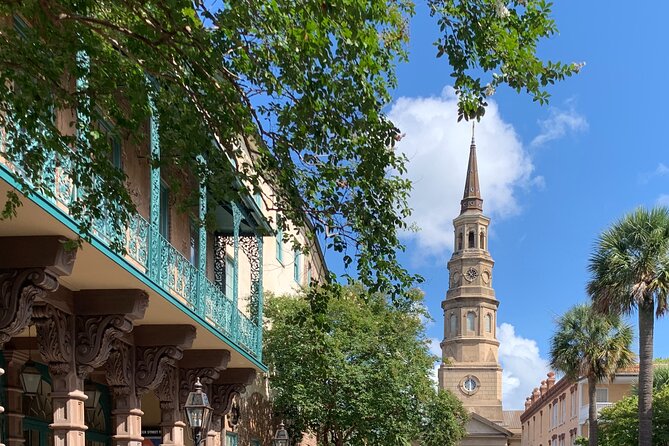
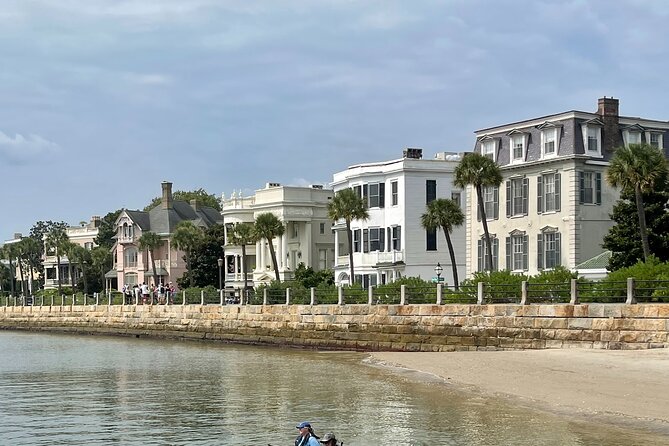
The Battery is a defensive seawall and promenade along Charleston Harbor. White Point Gardens adds open space and a change of pace after the close streets and tightly packed buildings.
This stop gives you a sense of Charleston’s position on the water. It is not only a scenic break. The Battery also helps explain the city’s defensive needs and its relationship with the harbor. Military-related facts are part of the tour’s wider subject matter, so this is one place where that thread feels especially relevant.
The tour allows about five minutes here. That is enough for an overview, but not for a leisurely promenade or a long stretch of harbor watching. If you want time to sit, take photographs, or study the waterfront, plan to return after the tour.
I like this stop because it changes the visual rhythm. You move from buildings and church fronts to a seawall and gardens. You also get a clearer sense of Charleston as a port city, not just a collection of historic streets.
French Huguenot Church and a distinct Charleston tradition

The French Huguenot Church was built in 1844. It is described as the oldest Gothic Revival church in South Carolina and the only independent Huguenot church in the country.
Those details make this a particularly useful stop for understanding Charleston’s religious variety. The building’s Gothic Revival design also gives the route another architectural style, rather than repeating the same colonial forms at every corner.
The visit lasts about five minutes, and admission is included. As with the other stops, the guide’s explanation carries much of the value. You’ll get a concise account of the church’s importance and its place in the city’s religious story.
The short timing is the only real limitation. If you are drawn to Gothic design or Huguenot history, you may want more time than the route allows. Treat this as an introduction, then decide if you want to return on your own.
Gullah culture keeps the tour from becoming a pretty-streets walk

One of the most important parts of the experience is the discussion of the Gullahs of Charleston. The supplied details do not name a separate Gullah site, so this appears to be a subject woven into the walk rather than a standalone stop.
That approach can work well. Charleston’s architecture is easy to admire, but a city tour should also address the people and traditions that shaped the place. Including Gullah culture gives the walk a broader purpose and helps you look past the most photographed buildings.
The quality of this section depends heavily on the guide. Joyce is praised for covering cultural highlights along with military and architectural subjects. That balance is useful because it keeps the tour from reducing Charleston to dates and decorative details.
You should listen for how the guide links culture to the streets around you. The information is likely to be most useful when it is tied to the city’s development rather than offered as a detached lecture. Since the tour is short, this will be an overview, not a complete study of Gullah history.
A guide-led walk with a personal feel
The strongest reported feature of this experience is its guiding. Joyce is described as enthusiastic, pleasant, and able to explain the city’s history in a lively way. The praise is specific: she covers city growth, military facts, architecture, and culture rather than repeating a narrow script.
The small group size supports that style. With no more than 10 people, you have a better chance of hearing clearly and asking questions. One booking even became a private tour because only two people attended. That is not guaranteed, but the small cap makes a quiet outing possible.
You should still keep expectations sensible. A two-hour walk cannot cover every major Charleston site, and five minutes at each named stop leaves little room for lengthy interior visits. The experience works best as a well-organized introduction, not as a full architectural or cultural course.
The tour also depends on dependable communication. One very poor experience involved a guide who did not appear, with no answer by phone or WhatsApp. The provider explained that the guide had been taken to the hospital and could not make contact. That is an understandable emergency, but the lack of a backup plan caused real disruption. The isolated incident is worth noting, especially if your schedule is tight.
Timing, walking effort, and what to bring
The activity lasts about two hours and requires a moderate level of physical fitness. You’ll be walking through the historic center, with stops at streets, churches, a theater, Rainbow Row, and the Battery.
Wear comfortable shoes. That advice is practical rather than glamorous, but it matters more than dressing for photographs alone. Since the tour requires good weather, check the forecast before setting out and allow flexibility in your plans.
Food and drinks are not included. Bring what you need for the walk, especially if the tour falls between meals. No transportation between stops is listed, so you should expect the experience to take place on foot from the Broad Street meeting point.
All sites seen on the tour are covered without extra payments. That makes the value easier to understand, even though no tour price is provided here. You cannot make a dollar-for-dollar judgment without the current rate, but included admission means you should not need to budget separate entry charges for the listed attractions.
Who will get the most from this tour
I would choose this walk if you have limited time in Charleston and want a broad first look. It combines landmark buildings, waterfront history, religious architecture, constitutional history, and Gullah culture in a compact outing.
It also suits you if you prefer a human guide over a map or audio app. Joyce’s described style, especially her mix of facts and personal warmth, is a strong reason to consider it. The group cap of 10 is another advantage for anyone who dislikes large sightseeing groups.
You may want something else if your priority is long interior visits, extensive free time at each stop, or a slow photography walk. The five-minute stop length keeps the route efficient, but it also limits independent exploration.
The tour is a good fit for first-time visitors, couples, families with older children, and anyone who wants historical orientation before exploring more on their own. It may be less suitable if you have difficulty walking for two hours or if your day cannot tolerate a weather-related change.
Should you book the Charleston History Tour?
Book it if you want a short, thoughtful introduction to central Charleston and value a guide who can connect architecture with culture and military history. The high overall rating, the 98 percent recommendation figure, Joyce’s strong praise, and the small group limit all point to a well-liked experience.
I would not book it as your only Charleston activity if you want deep access to every building. Think of it as a smart first chapter. Afterward, you can return to the Battery, Rainbow Row, or the French Huguenot Church with a better sense of why each place matters.
Free cancellation is available up to 24 hours before the start time. If poor weather cancels the tour, you’ll be offered another date or a full refund. That policy gives you useful flexibility, but the activity still works best when you leave room in your schedule.
FAQ
How long does the Charleston History Tour last?
The tour lasts approximately two hours.
Where does the tour begin?
It begins at 80 Broad St, Charleston, South Carolina 29401, USA.
Where does the tour end?
The activity ends back at the meeting point.
What locations are included?
The route includes Dock Street Theater, St. Michael’s Church, Rainbow Row, the Battery and White Point Gardens, and the French Huguenot Church. The tour also covers Gullah culture and a historic home connected with the ratification of the United States Constitution.
Are admission fees included?
Yes. The listed sites seen during the experience do not require additional payments.
What happens if the weather is poor?
The experience requires good weather. If it is canceled because of poor weather, you’ll be offered a different date or a full refund.
Recently reviewed around Charleston
- Kayak With Dolphins in Historic Shem Creek★ 5.0 · 407 reviews
- Charleston’s Best Highlights: History, Culture & Architecture★ 5.0 · 422 reviews
- 2-Hour Guided Kayak Eco Tour in Charleston★ 5.0 · 954 reviews
- Charleston Ghosts of Liberty Guided Walking Tour★ 4.5 · 473 reviews
- Undiscovered Charleston: Half Day Food, Wine & History Tour with Cooking Class★ 5.0 · 948 reviews
- Real Hauntings of Charleston! (Small Group Ghost Tour)★ 5.0 · 724 reviews
- Afternoon Schooner Sightseeing Dolphin Cruise on Charleston Harbor★ 4.5 · 620 reviews
- Private Daytime Horse-Drawn Carriage Tour of Charleston★ 5.0 · 340 reviews
Historical Tours, compared.

History and Hauntings of Salem Guided Walking Tour
Read our review →
Charleston’s Old South Carriage Historic Horse & Carriage Tour
Read our review →

Big Island in a Day: Volcanoes Waterfalls Sightseeing and History
Read our review →
Freedom Trail History Small Group Walking Tour
Read our review →
Historic Charleston Guided Sightseeing Walking Tour
Read our review →
Starship Landmark 90 Minute Sightseeing Cruise
Read our review →Browse the lists this tour appears in